
Adaptive Revise
Personalised, adaptive GCSE exam prep and revision.
View Series
Unlock a more personalised experience to discover special offers, suggested products and more!
Sign inDon’t have an account? Click to sign up today!

Over the last few decades, classrooms have undertaken a digital evolution. We’ve seen a wave of edtech providers leading to an increasing number of classrooms introduced into applications for student use, demonstrating how they can help improve student engagement, attainment and save teachers’ time.
But to what extent are these applications achieving these goals in practice?
The rise of technology has also seen a rise in the effects on young people – these include concentration difficulties, disrupted sleep, and negative impacts on wellbeing (2025 scoping review of 33 studies). This has created a friction point. Whilst it is important for students to be digital-forward, it is equally important that they are adequately protected. If we continue to integrate technology into the classroom, we need to bear in mind the health and wellbeing of staff and students.
According to DataReportal's Digital 2026 Global Overview Report, the average person now spends 6 hours and 45 minutes per day looking at screens. That figure has grown by more than 50 minutes per day since 2013 and shows no sign of slowing. This is the world in which children are growing up in, and how education responses to it matter significantly. The more useful question is not how much screen time children are getting, but what kind and whether it's designed to serve the learner or to hold their attention.
What was once a supplement to teaching has become, for many schools, the primary medium of it.
It’s no surprise that parental concern around screen usage is a pivotal issue in schools these days. When our team visited across Southeast Asia, and the Middle East in October 2025, more than half of schools told us that parents are worried about their children using digital devices at home.
56% of schools visited mentioned parental hesitancy and opposition to digital learning at home.
This wasn't a fringe view. It came from schools across levels, in different cities, and across very different cultures and socioeconomic contexts.
Parents reluctance pointed to four clear and understandable concerns:
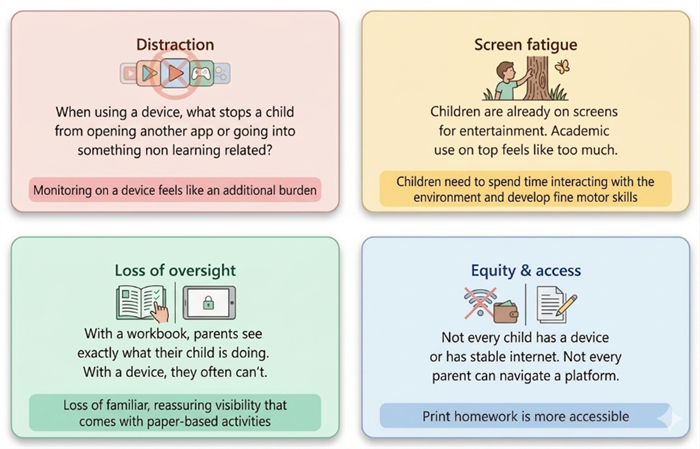
These concerns indicate that digital learning must be underpinned by proven efficacy, rather than adoption driven solely by its digital nature.
Teachers seem to be grappling with this tension too. In a school visit in England in early 2026, one secondary geography teacher reflected on what good digital practice requires: "The massive benefits come from using the platform in the right way at the right time," he said. "Platforms that just serve up content first only test short-term memory. The value is in what happens after – the retrieval, the reflection, the spaced practice." It is a distinction that matters, and one that well-designed digital tools can make structural rather than dependent on teacher skill alone.
Some schools are already finding that balance. That same teacher described a deliberate print-digital approach: printed knowledge organisers and retrieval flashcards as the foundation, with a digital adaptive platform used after blocks of teaching to reinforce and personalise practice.
"The platform complements the booklets," he explained, each doing what it does best.
It is a model worth noting; not digital replacing print, but both working together with a clear sense of purpose.
Ensuring learning technology is purposeful, balanced and effective and not just for novelty is a difficult balancing act, one that well-designed platforms should take into account. Instead of focusing on how long a child is looking at a screen, the focus should be on how they are using it. Even the choice of device shapes the experience. Across school visits, teachers consistently noted that tablets are associated – by children and parents alike – with entertainment, while laptops signal something closer to work. That distinction influences engagement before a child has even opened the first task.
One school visited in early 2026 told us they are actively phasing out tablets in favour of laptops for exactly this reason – a shift reflected more broadly in data from the DfE's Technology in Schools Survey 2024–25, which found laptops now available in 94% of secondary schools in England.
But device choice alone isn't enough – what matters equally is what children are actually asked to do on that device. The difference in practice can be striking: a child spending 20 minutes working through curriculum-aligned questions, checking their understanding, and reflecting on where they went wrong is having a fundamentally different experience from one who is passively consuming content or drilling rote answers without reflection.
Therefore, rather than just screen time, it can be thought of in three ways:
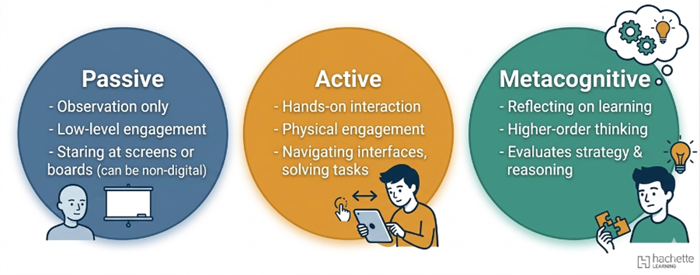
The general image of screen time is of passive consumption with apps that are deliberately designed to maximise engagement and keep the user scrolling – one parents are right to worry about. Active screen time is where most educational learning platforms sit. But neither is sufficient on its own. The most important and underrated is metacognitive screen time. This teaches children how to learn not just what to learn.
Research by the EEF, based on 355 studies across primary and secondary schools within the UK and internationally, suggests that metacognition – the ability to think about one's own thinking – helps children become more independent learners and is associated with meaningful improvements in academic performance, across all age groups and school phases.
Good digital learning can make metacognition a habit. When a student finishes a question and is asked not just for the answer but "How confident were you?" and "Did you find that easy or difficult?", something subtle but important happens: the child begins to pay attention to their own understanding, not just the correct response.
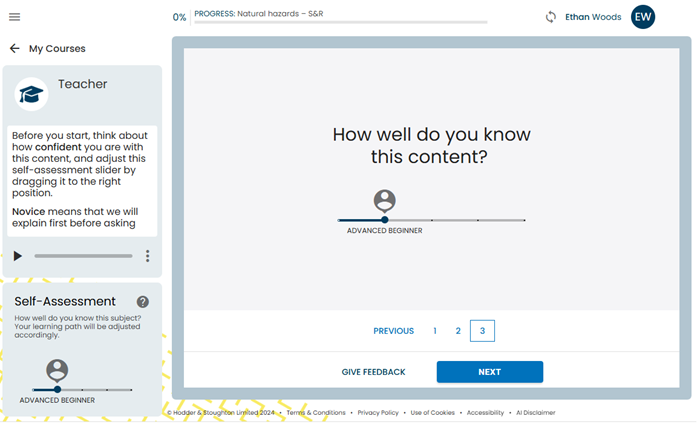
Metacognition self‑assessment question in an Adaptive Learn revision module.
Over time, this builds learners who are less dependent on being told whether they've done well – because they are beginning to know for themselves.
That said, it’s crucial that children develop healthy habits around technology – learning how to manage distraction, understand their own attention in order to navigate the digital world safely. This matters as much as the learning platforms themselves. Engaging purposefully and being guided and monitored is crucial.
"We must teach young people to live well with technology, not apart from it, cultivating the capacities of conscience, critical judgement and courage: qualities that enable young people to live ethically, wisely and resiliently in a world where online and offline realities are blended." Laura Knight, Education the child: literacy and wellbeing.
At Hachette Learning, the belief of striking a balance between online and offline realities shapes how we build products. Our digital tools are designed to sit alongside print resources, not replace them.
Hachette Learning believes that the appropriate amount of screen time should be different across age groups. It is also not just the quality but quantity of screen time that matters.
The answer isn't to avoid digital altogether, after all, it isn’t going anywhere, only advancing. However, it should not be the sole focus. To harness it effectively, a balance should be struck – something that connects the richness of a well-designed textbook and workbook with the personalisation, feedback, and insight that digital makes possible.
The question schools should be asking isn't how much screen time their students are getting. It's whether any of it is metacognitive.
That's the bar worth setting and the one that will define the best digital learning environments of the next decade.
More articles you may like:
Hachette Learning partners with Area9 Lyceum to deliver adaptive learning solutions
Why The Concord School loves Adaptive Learn
Are your class below age-related expectations? The report you need to know about.
Sources
DataReportal (2025). Digital 2026 Global Overview Report. https://datareportal.com/reports/digital-2026-global-overview-report
Department for Education (2025). Technology in Schools Survey: 2024–25.
https://www.gov.uk/government/publications/technology-in-schools-survey-report-2024-to-2025
Education Endowment Foundation (2025). Metacognition and Self‑Regulated Learning: Guidance Report (Second Edition). https://educationendowmentfoundation.org.uk/education-evidence/guidance-reports/metacognition
Hachette Learning (2025). Primary research based on school visits across Southeast Asia, the Middle East and Europe (October 2025).
Knight, L. (2025). Education, the Child: Literacy and Wellbeing. https://www.hachettelearning.com/blog/educating-the-child-digital-literacy-and-wellbeing
Curriculum changes. New materials. Price discounts and unmissable offers. We’ll make sure you don’t miss a thing with regular email updates, tailored by subject and age group.

