National Test-style Reading Assessments
Identify gaps and predict success with termly standardised assessments
NTS Assessments: Reading
Unlock a more personalised experience to discover special offers, suggested products and more!
Sign inDon’t have an account? Click to sign up today!In line with previous years, content domains 2b (retrieval) and 2d (inference) carried the most weighting on the 2025 KS2 SATs paper, together covering 39/50 marks, or 78%:
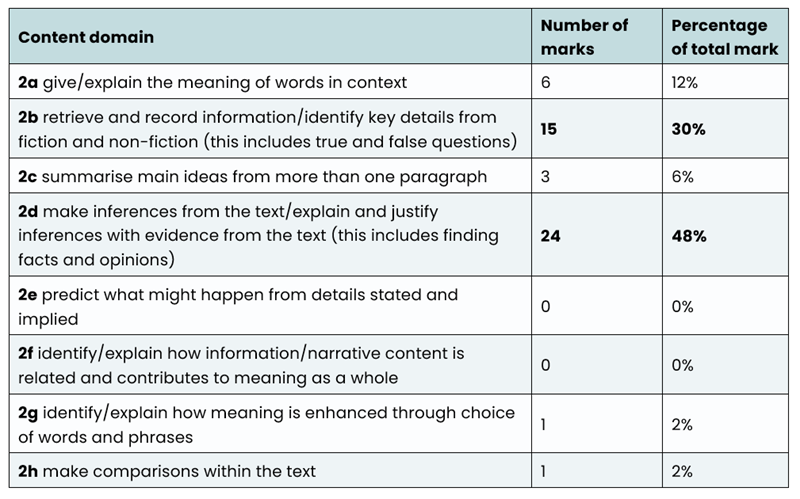
If we have a look at the 2025 Question Level Analysis (QLA), it’s no surprise that the inference questions were also the most challenging. This blog will unpick some of the trickiest questions and share some implications for teachers.
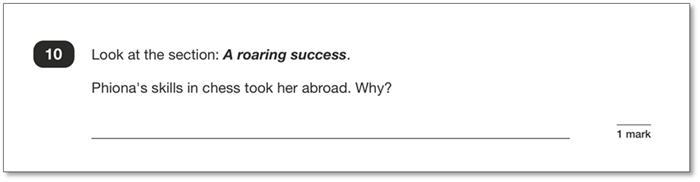
This is a 2b (retrieval) question where learners needed to retrieve and record information. 61.1% of learners answered this correctly. Learners were awarded marks for correctly answering that it was because she could play/compete against some of the best players in the world. This meant that learners needed to answer based on the text. Marks were not awarded for answers that resembled, ‘she was really good at it.’ This is because the question focused on why she went abroad, which was clearly stated: "She travelled to other countries to compete against some of the most experienced chess players in the world.", with the example given, "she took her first ever trip out of Uganda to attend a competition".
For example. ‘Look at page 7’ or ‘Look at the section beginning…’
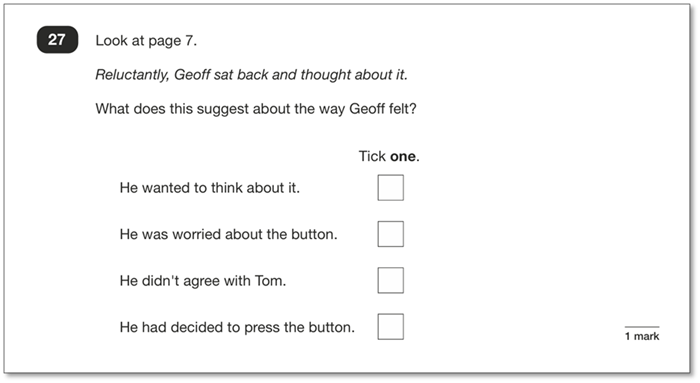
This was a particularly tricky question with only 48.1% of learners answering it correctly (He didn't agree with Tom). It required learners to read the whole page and use the text to answer the question. The word ‘reluctantly’ also gives a clue to the fact that Geoff did not agree with Tom. Learners needed to read the whole section to understand which answers were not quite correct. It would be easy to choose ‘He had decided to press the button’ but it was Tom who told him not to press the button.
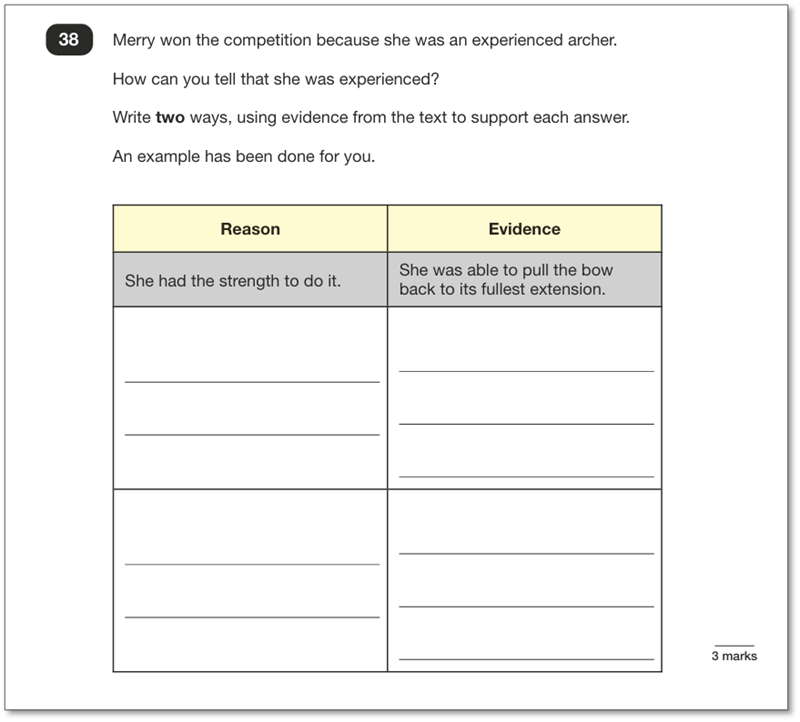
Although this question is heavily scaffolded with boxes to support learners, it still requires some teaching of test techniques. There is a model answer to support learners, but they still found this question tricky with only 34.8% of marks being awarded (the average mark was just over 1/3). I think that there is a perception that learners need to write lots to get the full three marks, but this is not the case, as shown below.
Learners would benefit from understanding that questions like this require a point and evidence, or ‘PePe’ as some learners call it:
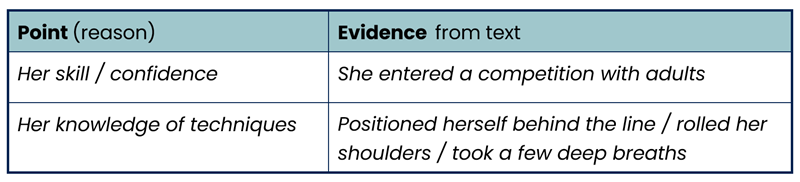
Learners are awarded 3 marks for two acceptable points, at least one with evidence. The second point without evidence can be sufficient for a learner to achieve 3 marks. I like to teach learners to always give evidence for both questions – just in case! This question requires explicit teaching where teachers should articulate their thought process and show how they use the text to find clues about why Merry was experienced.
Wilkinson, S. (2025) Why are stories and background knowledge essential for reading comprehension? Accessed: https://www.hachettelearning.com/blog/excellence-and-equity-through-disciplinary-literacy-why-are-stories-and-background-knowledge-essent
Shareen is an experienced education adviser and is an executive leader for a multi-academy trust, with over 20 years' experience in education. She has been writing educational resources and books for over a decade and is the co-author of Hachhette Learning's popular Achieve SATs Success: Reading series and author of Disciplinary literacy in primary schools. From time to time, Shareen works with the DfE Standards and Testing Agency, as a KS1 and KS2 reading and grammar quality assurance subject expert proofer and sits on various expert review groups.
Curriculum changes. New materials. Price discounts and unmissable offers. We’ll make sure you don’t miss a thing with regular email updates, tailored by subject and age group.