Ages 3-4
Create a firm foundation for literacy
Go to First StepsUnlock a more personalised experience to discover special offers, suggested products and more!
Sign inDon’t have an account? Click to sign up today!

The final step in the Rocket Phonics journey, for pupils aged 6-7.
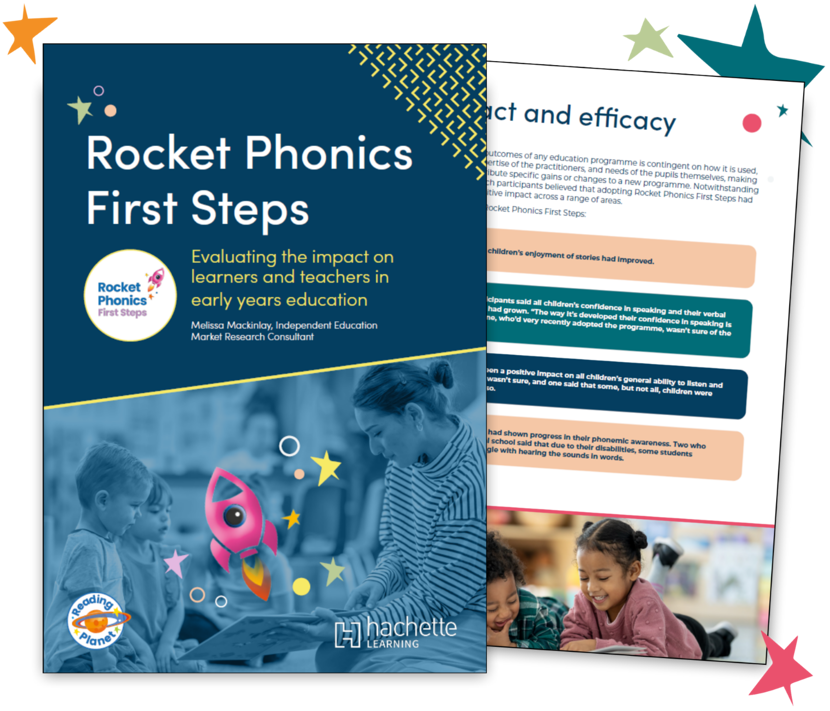
The impact of Rocket Phonics First Steps
Evaluating the impact of Rocket Phonics First Steps on learners and teachers in early years education
This report shares the experiences of schools involved in trialling Rocket Phonics First Steps, and sets out what this means for those considering adopting a new SSP programme for children in Early Years. The report draws on qualitative data from 11 UK primary schools with EYFS provision, one special school and one independent standalone nursery.
Written by Melissa Mackinlay, Independent Education and Market Research Consultant
Rocket Phonics First Steps works. Across the research sample, all participants, including SLT and nursery practitioners, said that they could see an impact on children’s progress and development across a range of areas. “We’ve seen the benefit on children’s acquisition of phonics sounds and how they’re learning and retaining those, developing phoneme grapheme correspondence which means they’re readier to start a formal programme [in Reception]”.
The structure and progression mean that practitioners can identify children who are struggling with a sound and quickly put in place additional support. “…the order of the speech sounds … follows their development which helps their communication and language. I’ve seen an impact already with children who need support around the pronunciations of those sounds.”
Compared with children who were joining Reception from settings which had not used it, pupils who had followed Rocket Phonics First Steps were more secure in their learning, and familiar with the routine of a structured daily phonics session. “[Colleagues in Reception] said they could see a huge difference in those children that had done it the year before in comparison to those that come in from external nurseries that had never done it before.”
Adopting Rocket Phonics First Steps has boosted staff confidence through the provision of practical training and easy-to-use resources. The daily lesson plans provide clear step-by-step support, and the consistent structure makes it easy to embed it into their provision. “We have that confidence – we’re doing this in nursery and we know what we’re doing.”
Rocket Phonics First Steps is more than just a phonics programme: it is based on an holistic approach to developing speech and language. “We love the fact it’s a phonics programme and language programme combined… it’s your vocab, it’s your writing, your understanding, your comprehension, it’s all the [elements]. They all draw together.”
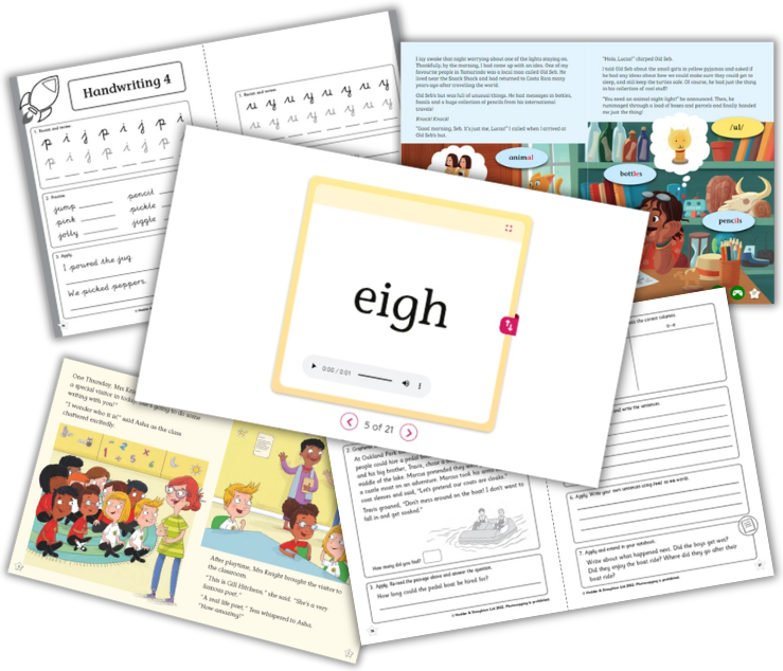
We love the way that aspects of grammar, spelling and handwriting are interwoven into the scheme.
The termly overviews are fantastic! It is clear there is sufficient challenge and progression moving forward from Year 1.
It gives children secure foundations in reading and spelling in preparation for learning in Key Stage 2. Children who arrive to our school new from other countries have also benefited from the scheme.
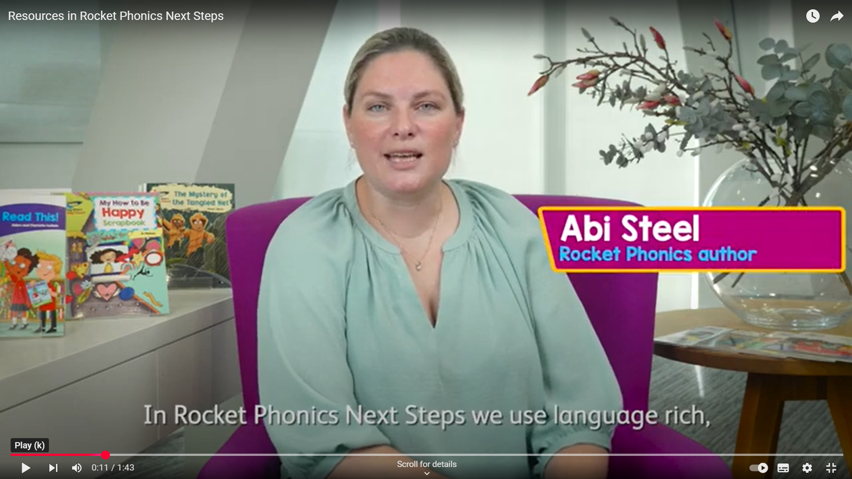
In Next Steps, children do not learn any new letter-sounds. Instead, they consolidate their knowledge of sounds by revisiting all the alphabetic code from the previous years. The alphabetic code is revised by grouping it by individual phoneme and looking at the different ways of spelling that sound (an example would be the sound /ai/ which can be spelt in a variety of different ways). In Next Steps, we introduce cursive handwriting and explicitly cover National Curriculum spelling requirements.
Curriculum changes. New materials. Price discounts and unmissable offers. We’ll make sure you don’t miss a thing with regular email updates, tailored by subject and age group.