Sign in for a more personalised experience
Unlock a more personalised experience to discover special offers, suggested products and more!
Sign inDon’t have an account? Click to sign up today!blog
7/21/2026
Curriculum and Assessment Review: What schools know so far


“Evolution, not revolution” - what the curriculum review really means for schools
The Curriculum and Assessment Review (CAR), and the government's response, published in November 2025, set out the direction of travel for schools. Unlike the reforms introduced in 2014, the government’s response points towards a more evolutionary, phased approach rather than wholesale immediate reform. The focus seems to be on building on established strengths and make considered improvements over time.
So, what does this mean for schools? Do teachers need to start redesigning their curriculum now, and what changes should they be planning for over the coming years?
The answer is: there will not be an immediate need for wholesale curriculum redesign. However, the government's response does signal that a number of changes are coming that schools will need to keep an eye on and respond to.
The timeline below provides an overview of the key changes and when schools can expect them to take place: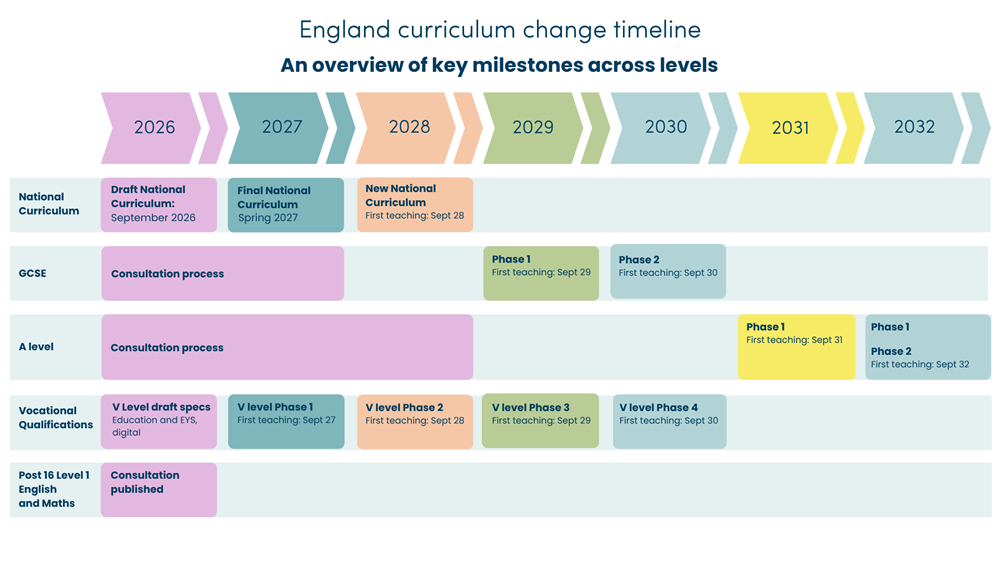
One of the clear priorities is improving progression and coherence within and between key stages, with horizontal links across subjects and vertical links within subjects, to ensure continuity rather than repetition.
The government also plans to strengthen the focus on key knowledge and skills across subjects, including financial literacy, digital literacy, media literacy, climate education and oracy.
The review also recommended considering the inclusion of Religious Education within the National Curriculum. However, this should be viewed as a recommendation from the review rather than a confirmed reform at this stage.
 strong foundations in literacy and numeracy to ensure readiness for secondary education. The government also intends to strengthen the focus on reading and oracy, with more attention on helping pupils develop speaking and listening skills.
For primary schools, this means continuing to prioritise strong foundations while considering how reading, writing, oracy and wider knowledge and skills are developed and sequenced across the curriculum.
The review and response also highlight the importance of supporting pupils with SEND. Schools can expect further guidance and support to develop inclusive approaches to curriculum delivery and assessment.
At Key Stages 3 and 4, including GCSE, as well as AS and A Level, the government intends to refresh all core subjects (English, maths and science) and foundation (such as music, modern foreign languages, history and geography).
Different areas of the curriculum will develop at different times, so schools should expect a gradual process.
Secondary assessment is also set to change. The government will work towards reducing the amount of time pupils spend in GCSE examinations by an average of 2.5-3 hours overall.
The DfE is also placing greater emphasis on schools assessing pupil progress in writing and maths in KS3, and a new compulsory Year 8 reading test is likely to be introduced between 2028 and 2029 to monitor and boost literacy standards.
 The vocational landscape is also set for change, with a drive to streamline qualifications and create a coherent Level 3 offer.
V Levels are planned as a new applied vocational alternative to A Levels and T Levels at Level 3, recognising that a single route doesn’t suit every learner. These will be rolled out between 2027 and 2030, so any impact will build over time. Alongside this, many existing Level 3 vocational qualifications – including BTECs and Cambridge Technicals – will be phased out.
T levels will remain central to the technical education landscape, with further rollout into additional subject areas and ongoing refinement of existing courses. Taken together, these changes will reshape the post-16 landscape in phases, not all at once.
The key message is that this will be a period of planned, phased change rather than immediate overhaul. Schools will not need to redesign their curriculum overnight, but they will want to keep a close eye on evolving guidance, qualifications and assessment expectations.
Hachette Learning is committed to supporting this transition through high-quality resources that enable every learner to reach their unique potential, working in partnership with booksellers, schools, educators, and the wider education community as these reforms take shape. We will continue to provide updates as more details become available.
We will continue to follow developments closely and share further updates as more details become available.
So, what does this mean for schools? Do teachers need to start redesigning their curriculum now, and what changes should they be planning for over the coming years?
The answer is: there will not be an immediate need for wholesale curriculum redesign. However, the government's response does signal that a number of changes are coming that schools will need to keep an eye on and respond to.
When will the Curriculum and Assessment Review changes be implemented?
The changes outlined in the government’s response will be introduced over a number of years, with different reforms progressing at different times.The timeline below provides an overview of the key changes and when schools can expect them to take place:
What changes will the Curriculum and Assessment Review bring across the curriculum?
Alongside subject-specific updates, the review also points to some important themes that run across the whole curriculum.One of the clear priorities is improving progression and coherence within and between key stages, with horizontal links across subjects and vertical links within subjects, to ensure continuity rather than repetition.
The government also plans to strengthen the focus on key knowledge and skills across subjects, including financial literacy, digital literacy, media literacy, climate education and oracy.
The review also recommended considering the inclusion of Religious Education within the National Curriculum. However, this should be viewed as a recommendation from the review rather than a confirmed reform at this stage.
What will the Curriculum and Assessment Review mean for primary schools?
At primary level, the focus stays firmly on building strong foundations in literacy and numeracy to ensure readiness for secondary education. The government also intends to strengthen the focus on reading and oracy, with more attention on helping pupils develop speaking and listening skills. For primary schools, this means continuing to prioritise strong foundations while considering how reading, writing, oracy and wider knowledge and skills are developed and sequenced across the curriculum.
The review and response also highlight the importance of supporting pupils with SEND. Schools can expect further guidance and support to develop inclusive approaches to curriculum delivery and assessment.
What will change for secondary schools and GCSE assessment?
At Key Stages 3 and 4, including GCSE, as well as AS and A Level, the government intends to refresh all core subjects (English, maths and science) and foundation (such as music, modern foreign languages, history and geography). Different areas of the curriculum will develop at different times, so schools should expect a gradual process.
Secondary assessment is also set to change. The government will work towards reducing the amount of time pupils spend in GCSE examinations by an average of 2.5-3 hours overall.
The DfE is also placing greater emphasis on schools assessing pupil progress in writing and maths in KS3, and a new compulsory Year 8 reading test is likely to be introduced between 2028 and 2029 to monitor and boost literacy standards.
What will happen to Level 3 and vocational qualifications?
The vocational landscape is also set for change, with a drive to streamline qualifications and create a coherent Level 3 offer. V Levels are planned as a new applied vocational alternative to A Levels and T Levels at Level 3, recognising that a single route doesn’t suit every learner. These will be rolled out between 2027 and 2030, so any impact will build over time. Alongside this, many existing Level 3 vocational qualifications – including BTECs and Cambridge Technicals – will be phased out.
T levels will remain central to the technical education landscape, with further rollout into additional subject areas and ongoing refinement of existing courses. Taken together, these changes will reshape the post-16 landscape in phases, not all at once.
What should schools do now to prepare?
The key message is that this will be a period of planned, phased change rather than immediate overhaul. Schools will not need to redesign their curriculum overnight, but they will want to keep a close eye on evolving guidance, qualifications and assessment expectations. Hachette Learning is committed to supporting this transition through high-quality resources that enable every learner to reach their unique potential, working in partnership with booksellers, schools, educators, and the wider education community as these reforms take shape. We will continue to provide updates as more details become available.
We will continue to follow developments closely and share further updates as more details become available.
Hear from us
Curriculum changes. New materials. Price discounts and unmissable offers. We’ll make sure you don’t miss a thing with regular email updates, tailored by subject and age group.