Sign in for a more personalised experience
Unlock a more personalised experience to discover special offers, suggested products and more!
Sign inDon’t have an account? Click to sign up today!2025 KS2 Maths SATs: Implications for Teaching
Maths specialists Sarah-Anne Fernandes and Trevor Dixon share their views on how to prepare learners for the 2026 SATs mathematics paper, based on implications from the 2025 test.
1. Ensure 'Number' is nailed!
This table shows the emphasis placed on Number (including Calculations, Fractions, Decimals, Percentages, Ratio and Algebra) compared with Measurement, Geometry and Statistics from 2016 to 2024. Every year, Number accounts for over 80 marks.
| KS2 national test | Number, Ratio and Algebra marks (/110) | Measurement, Geometry & Statistics marks (/110) |
|---|---|---|
|
2025 |
89 (81%) | 21 (19%) |
| 2024 | 86 (78%) | 24 (22%) |
| 2023 | 87 (79%) | 23 (21%) |
| 2022 | 85 (77%) | 25 (23%) |
| 2019 | 84 (76%) | 26 (24%) |
| 2018 | 88 (80%) | 22 (20%) |
| 2017 | 85 (77%) | 25 (23%) |
| 2016 | 86 (78%) | 24 (22%) |
Note that calculation of marks is based on primary codes only and percentages have been rounded to the nearest whole.
2. Teach the whole curriculum so learners have ‘real-life’ maths skills
Despite the number of marks allocated to Measurement, Geometry and Statistics being less than 30 marks, it is important to ensure that learners gain a solid understanding of these areas and teaching of this curriculum content is not overlooked.
This year, only 59.2% of learners were able to successfully change times on clock faces from a.m. and p.m. times to 24-hour digital times, despite this being a Year 3 objective.
Paper 3: Q12
3M4b* | 59.2% answered correctly nationally:

3. Consolidate and revise learning from the whole of Key Stage 2
This table shows the percentage weighting of total marks across all three papers that were allocated to each of the Key Stage 2 Year groups in 2025:
| Year group | Number of marks across all three papers (/110 marks) | Percentage weighting of total marks |
|---|---|---|
| 3 | 10 | 9% |
| 4 | 21 | 19% |
| 5 | 32 | 29% |
| 6 | 47 | 43% |
If we compare this to the year group distribution from previous years, we can see in this chart that the content drawn from each year group is broadly balanced year on year – therefore it is important to note the tests are not ‘Year 6 tests’ but are rather ‘Key Stage 2 tests’. Planned opportunities to consolidate and revise learning from previous year groups are paramount, especially with maths curriculum areas that aren’t identified in Year 6, such as Time and areas of Statistics, e.g. pictograms.

4. Secure long multiplication and division
Paper 1 always includes four questions that assess long multiplication and long division, which is equivalent to 8 marks. The percentage of learners gaining the full 2 marks in each of these four questions in 2025 was quite positive. However, there is still scope for this to be improved nationally, especially with the trickier long division question (Q34).
| Question | Marks | Correct response: national % | |
|---|---|---|---|
| Q14 | 614 x 32 | 2 | 86.0% |
| Q28 | 884 ÷ 17 | 2 | 70.2% |
| Q30 | 6419 x 74 | 2 | 67.2% |
| Q34 | 8190 ÷ 45 | 2 | 53.2% |
5. Spend a good amount of time teaching fractions
As can been seen from this pie chart, Fractions, Decimals and Percentages continue to be very prevalent in the 2025 national tests. In fact, a quarter of all marks across the three maths papers were allocated to this domain.

The teaching and learning of fractions have always been a challenge. Fractions nearly always use smaller denominators. The largest denominator used this year in Paper 1 was Q22 (  +
+  +
+  = ). It would seem to make sense therefore to concentrate on using fractions with these smaller denominators.
These Paper 1 fraction questions seem to have been the most challenging in 2025:
Paper 1: Q33
5F5 | 43.1% answered correctly nationally:

Teach and practise a specific strategy for this type of calculation. Here, a partition strategy could be used:
3  × 12 = (3 × 12) + ( × 12) = 36 + 4 = 40
Paper 1: Q35
5F5 | 48.6% answered correctly nationally:

Learners can become confused by multiplying by a fraction. If they are made aware that in this instance ‘×’ and ‘of’ are interchangeable, then this can become more accessible. Finding a fraction of a whole number is a Year 4 objective, but in Year 4, these questions are unlikely to be presented with a multiplication symbol.
Paper 1: Q36
6F4 | 46.2% answered correctly nationally:

Calculations like this are amongst the hardest faced by Key Stage 2 learners. There are a number of concepts needed to successfully complete this subtraction. Learners need to be familiar with:
• mixed numbers and what they mean
• converting fractions with the same denominators
• partitioning mixed numbers into wholes and fractions
• selecting a strategy they are comfortable with using (using decomposition for subtraction of fractions should only be practised by more able learners and smaller denominators).
- Without decomposition:
4  – 1 = 4
  – 1
– 1  = 3
= 3  = 3
= 3 
- With decomposition/a number line:
1 +  +
+  = 1
= 1 

- With decomposition/improper fractions:
3 – 1  = 3 – 1 =
  –
–  =
=  = 1
= 1
Fractions questions in Paper 2 and Paper 3 also proved challenging:
Paper 2: Q16
4F10b (primary code only) | 44.6% answered correctly nationally:

Learners need to be familiar with the equivalence of fractions and decimals. Converting fractions to decimals likely leads to an easier subtraction to find the difference. Also, it is easier to see that the subtraction should be:
1.4 – 1.25 = rather than 1 – 1  =
=
Paper 2: Q21
5F10 (primary code only) | 37.2% answered correctly nationally:

Learners need to be familiar with multiplying decimals by 10 and 100, know what ‘difference’ means and organise the subtraction. That this question is set as a word problem makes the interpretation more challenging.
Paper 3: Q13
5F6a (primary code only) | 53.3% answered correctly nationally:

Learners need to be familiar with converting between decimals and fractions and finding equivalence of hundredths and thousandths or between two- and three-decimal places.
In this case the learners need to reach:


or
0.09 0.009 0.099 0.009
before being able to order the numbers.
Paper 3: Q20
6F5a | 45.9% answered correctly nationally:

An awareness of shape and space is needed with this question as well as an understanding of fractions. Learners need to appreciate that each of the three medium-sized triangles is equivalent to four smaller-sized triangles.
6. Insist learners show their working out
Over the years, word problems have often been a source of difficulty, even when the underlying arithmetic can be straightforward. All word problems appear on Papers 2 and 3.
Word problems have been divided into groups:
• By context: Full context/minimal context/no context
• By question type: Show your method/no method/explain
This table shows the distribution of these groups of questions:
| Word problems: Papers 2 and 3 | ||||||
|---|---|---|---|---|---|---|
| Show your method | No method | Explain | ||||
| Paper 2 | Paper 3 | Paper 2 | Paper 3 | Paper 2 | Paper 3 | |
| Total marks: | 21 marks | 47 marks | 2 marks | |||
| Full context |
Q11 (2) |
Q6 (2) |
Q13 (2) | Q4 (1) Q10 (2) Q15 (2) |
Q16 (1) | |
| Total marks in full context: | 13 marks | 7 marks | 1 mark | |||
| Minimal context |
Q16 (2) Q21 (2) |
Q19 (2) | Q3 (1) Q5 (1) Q9 (2) Q10 (1) Q17 (1) Q20 (2) |
Q3 (1) | Q12 (1) | |
| Total marks in minimal context: | 6 marks | 9 marks | 1 mark | |||
| No context | Q22 (2) | Q1 (1) Q2 (2) Q4 (1) Q6 (2) Q7 (2) Q8 (1) Q15 (1) Q18 (2) Q22 (1) Q23 (1) |
Q1 (1) Q2 (1) Q5 (1) Q7 (2) Q9 (2) Q11 (1) Q12 (1) Q13 (1) Q14 (2) Q18 (2) Q20 (1) Q21 (2) |
|||
| Total marks in no context: | 2 marks | 31 marks | - | |||
It is interesting to note that on Papers 2 and 3, 30% of the marks are 2-mark ‘Show your method’ questions. This means that there are 11 marks available as method marks. Learners need to be encouraged to show their method, even when they think they are confident that they know the answers.
7. Model and encourage learners to use correct mathematical vocabulary
It comes as no surprise that for learners to be successful at solving the vast range of questions, they need to have a secure understanding of mathematical vocabulary and key mathematical conversion facts. This table highlights the key terms/facts they would have needed to know in this year’s papers:
| 2025: Mathematical terms and facts that learners needed to know | |
| Paper 2 | Paper 3 |
| Right angle Coordinate Reflection Percentage Difference Total Prime numbers Volume |
Improper fraction Square numbers Prime numbers |
8. Expose learners to a rich mathematical diet with a variety of problem-solving
Paper 2: Q20
6A5 (primary code only) | 50% answered correctly nationally:

Apart from knowing what a prime number is, learners need practice at listing all possible options in a mathematical context. Learners also need to understand that some questions can have more than one answer.
Paper 3: Q19
6R1 (primary code only) | 50.4% answered correctly nationally

This is a kind of logic or puzzle problem. Familiarity with a variety of mathematical puzzles will help learners when faced with questions like this. The arithmetic involved is not challenging:
22 ÷ 5 = 4.4
4.4 × 3 = 13.2
However, the process involved would be challenging for learners who are not used to working with a variety of puzzles and problems set in different contexts.
Paper 3: Q21
5C5a (primary code only) | 53.5% answered correctly nationally

To answer this puzzle-type question, learners need to be able to say to themselves, “What do I know about the missing number?” and “What could it be?”. Then they need to narrow down the possibilities to arrive at a solution that meets all the given facts.
Again, practice with this type of question will be key, but also strategies to help learners need to be demonstrated and explained.
Paper 3 Q16
6S1 (primary code only) | 67% answered correctly nationally

Mathematical reasoning should be an integral part of mathematical understanding. Here, learners need to use their interpretation skills to understand the pie chart and their knowledge of fractions to prove why the statement is incorrect. Model how to write and prove mathematical statements using maths calculations to support explanations:
Tin A is 36 ÷ 3 = 12 and Tin B is 20 ÷ 2 = 10
About Sarah-Anne Fernandes and Trevor Dixon (@SMASHMaths)
Sarah-Anne Fernandes is a leading UK Mathematics Educational Consultant who has had the privilege of working with several schools and school leaders across the country to help them improve maths curriculum teaching and results. She loves to teach and has first-hand experience of helping learners pass 7+ and 11+ entrance exams with great success. Over the years, Sarah-Anne has been commissioned to be an author and Series Editor for a range of titles for leading educational publishers.
Trevor Dixon has over 35 years' teaching experience; working for nearly 30 years as a maths subject leader in three different primary schools. He is a former Advanced Skills Teacher, specialising in mathematics teaching and learning. He is an Associate of the National Centre for Excellence in the Teaching of Mathematics. He also holds the Mathematics Association Diploma of Mathematical Education alongside his degree and teaching qualifications.
Identify gaps and predict success
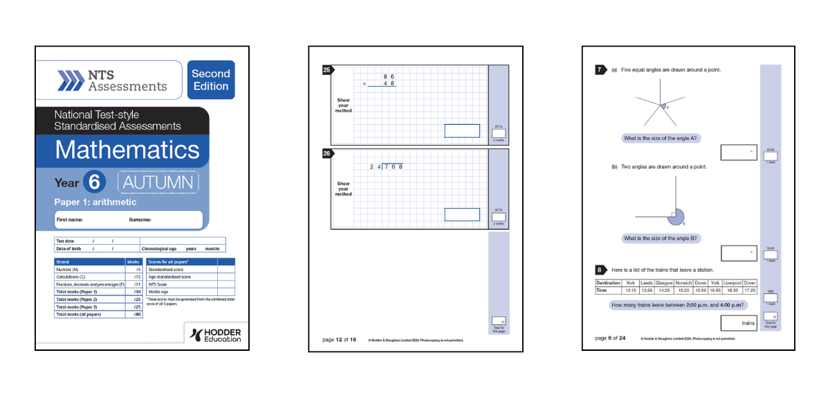
with NTS Mathematics (second edition).
Termly National Test-style Standardised (NTS) Assessments reflect SATs in format, design and demand, helping to prepare learners for their SATs with termly assessments from Year 1.
Benchmark attainment with valid and reliable standardised scores, effortlessly track progress and identify gaps whilst generating accurate performance indicators.
Read our latest correlation report to see just how reliable NTS predictions are.
Get ready for SATs
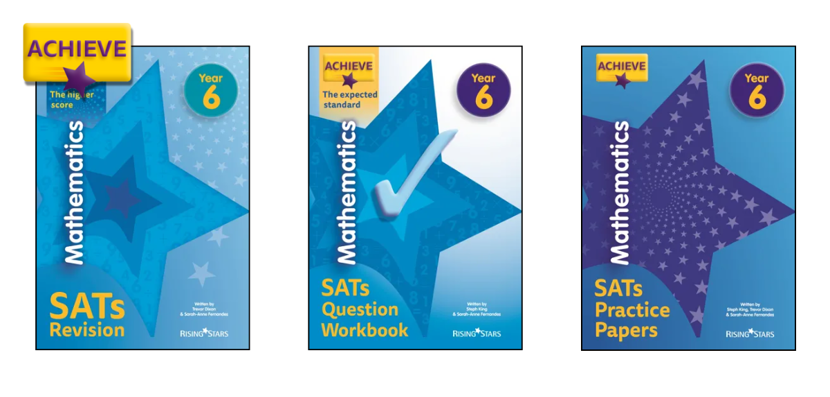
with Achieve SATs Success: Grammar, Spelling and Punctuation.
Help every learner reach their full potential in three steps:
- Revision Books refresh and boost knowledge in a step-by-step approach.
- Question Workbooks reinforce and apply knowledge to consolidate learning.
- Practice Papers build confidence and identify areas of difficulty ahead of National Tests.
Revision Books and Question Workbooks are available as 'expected standard' and 'higher score' editions to suit each learner.
Hear from us
Curriculum changes. New materials. Price discounts and unmissable offers. We’ll make sure you don’t miss a thing with regular email updates, tailored by subject and age group.