Sign in for a more personalised experience
Unlock a more personalised experience to discover special offers, suggested products and more!
Sign inDon’t have an account? Click to sign up today!Slice Teams: From Top-Down Failure to Lasting School Improvement
School improvement efforts routinely fail to achieve their intended impact. Teacher surveys, organisational research and large-scale evaluations all point to the same conclusion: only about 20-30 per cent of initiatives lead to measurable, sustained improvements in pupil outcomes. In practice, the success rate may be even lower.
This pattern is not unique to education; it mirrors findings from healthcare, public services and major philanthropic programmes. Two structural issues underpin this persistently low success rate.
Two structural issues
First, teachers and school leaders are not taught the practical disciplines of implementation and improvement science, including how to diagnose problems precisely, design workable strategies, build routines, collect meaningful evidence, or sustain change over time.
Second, school improvement is dominated by top-down decision-making. This model works for simple problems that lend themselves to straightforward solutions, but is ill-suited to the adaptive, relational and context-dependent nature of whole-school improvement.
Top-down decision-making can be effective when a problem is simple, the solution is clear and compliance can be enforced uniformly. School improvement does not fall into this category. Schools are complex systems in which outcomes emerge from dynamic interactions between people, routines and contexts. Cause and effect are non-linear; strategies that work in one classroom may fail in another; and success depends on relationships, trust and responsiveness.
The two structural problems outlined above – a lack of training in implementation and improvement science, and the limitations of top-down change – suggest the need for a different approach to school improvement. An effective model must:
(a) collate and cultivate expertise rather than centralise it
(b) generate trust and buy-in rather than compliance, and
(c) create the conditions for disciplined, iterative learning.
Slice teams: a practical, scalable solution
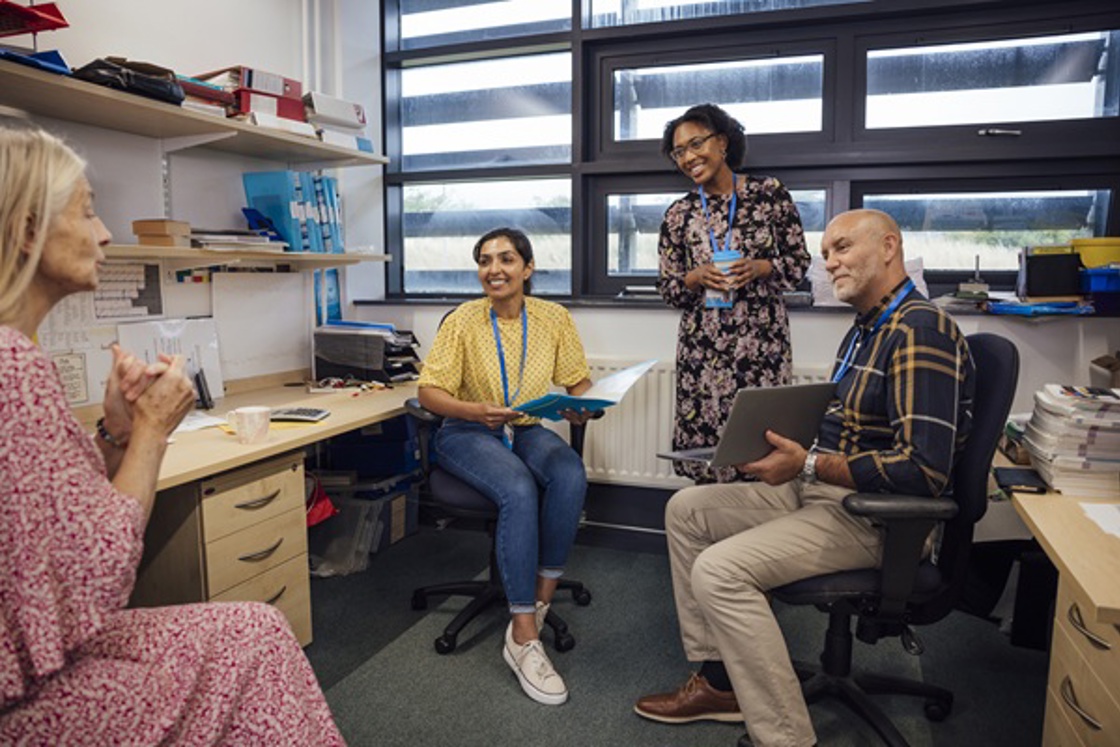
Slice teams offer a practical, scalable solution to these structural weaknesses. A slice team is a diverse, representative group that brings together stakeholders from throughout the school community to identify problems, design improvements, test ideas, gather evidence and refine strategies. The group should be small, diverse and represent a cross-section of the organisation. In schools, this typically includes senior leaders, middle leaders, teachers, the SENDCo, classroom assistants, governors and support staff. Wherever appropriate, parent/carer and student voices should also be included. These are ultimately the most important stakeholders in education, and their insights can be vital – though they need not be involved at every stage. Often, targeted involvement during problem definition, early design consultation or impact evaluation is sufficient.
The key idea is that improvement work is shaped by multiple perspectives, not a narrow leadership view. Slice teams lead a structured process of diagnosis, design, testing, evidence collection and refinement, acting both as an engine of innovation and as a bridge between senior leadership and the wider school community.
Possible modes
Slice teams can operate in different modes depending on a school’s context and capacity:
(a) Consultation. Leaders design the improvement strategy but invite a slice team to provide a one-off or occasional consultation at key decision points. The aim is to surface insights, risks and blind spots before plans are finalised.
(b) Steering group. In this model, senior leaders drive the improvement effort and report regularly to a slice team to share progress and to receive feedback and accountability.
(c) Working party. This is the most time-intensive model, but it offers the greatest benefits in terms of trust, buy-in and implementation quality. Here, decision-making is devolved to the slice team, who take responsibility for planning, testing and implementation.
Slice teams deepen diagnostic accuracy, build trust and ownership, enable rapid feedback loops and build leadership capacity. These mechanisms directly address the causes of implementation failure, making improvement more reliable.
The status quo – where most change efforts fail to produce lasting impact – is not inevitable. By adopting the lessons of improvement and implementation science, and by placing slice teams at the heart of school improvement, it is possible to build a more reliable, humane and effective approach to change. This shift would not only improve teaching and learning, but would materially enhance the life chances of children and young people.
This blog is taken from a longer white paper, which you can access here: Slice Teams: From Top-Down Failure to Lasting School Improvement.
Dr James Mannion is a teacher trainer and government advisor specialising in implementation and improvement science. He is the creator of Making Change Stick, a comprehensive school improvement programme developed over ten years with schools across the UK and internationally. This long-term effort forms the basis of his book Making Change Stick: A Practical Guide to Implementing School Improvement (Hachette Learning, 2025).
Hear from us
Curriculum changes. New materials. Price discounts and unmissable offers. We’ll make sure you don’t miss a thing with regular email updates, tailored by subject and age group.