Ages 3-4
Create a firm foundation for literacy
First StepsUnlock a more personalised experience to discover special offers, suggested products and more!
Sign inDon’t have an account? Click to sign up today!
 Adopting Rocket Phonics First Steps across three schools in Shireland Collegiate Academy Trust
The drive to improve early literacy outcomes is at the heart of Shireland Collegiate Academy Trust’s Early Years’ mission. When deciding on a validated SSP to support Phases 1 and 2 of Letters and Sounds, the Trust sought a phonics programme that was research-informed and developed through a partnership-based approach with the programme’s publisher. “It meant we were able to have a dialogue with them about what the phonics scheme would look like and how it would support our schools. We felt listened to and our comments were taken on board”, explained Sian. Now the Vice Principal of Wallbrook Primary Academy, Sian had previously been part of the central team at Shireland responsible for implementing Rocket Phonics across all their primary schools.
Kirsty Grundy, Primary Director, and Jennifer Devaney, Senior School Improvement Lead for Primaries, at Shireland Collegiate Academy Trust, commented that:
“Introducing Rocket Phonics has transformed our teaching of phonics. With its clear structure, accessible training, and research-informed progression, every member of staff feels empowered to deliver phonics with confidence and consistency. Most importantly, children are more engaged, more confident in their phonic knowledge and are developing a real love of reading.”
Adopting the same programme in their pre-school provision meant continuity in children’s learning and a smooth transition between the Early Years and Key Stage 1 curriculum, both of which are key goals of the Trust’s Early Years’ policy.
This case study draws on feedback from the following members of staff at three of the Trust’s primary schools:
Two of the schools serve communities in economic hardship, with high levels of EAL, and many children join the preschool provision with speech and language delays. With most children continuing into their school’s Reception, school leaders supported the introduction of a structured and consistent phonics programme from the earliest days.
The introduction of Rocket Phonics First Steps across the three schools was carefully planned to ensure that all staff, including TAs, were confident about how to use the programme’s resources in their settings. Inset sessions were run in which senior literacy colleagues modelled the use of the resources and walked and talked the EYFS team through the resources available on Boost, Hachette Learning’s online platform. Short, practical videos featuring the Rocket Phonics programme’s author, Abigail Steel, were also shared with staff. Being able to access everything in one place has been a real asset, says Sian. “Everything’s on Boost. Teachers can access the planning and all the resources, and it’s very easy to use.”
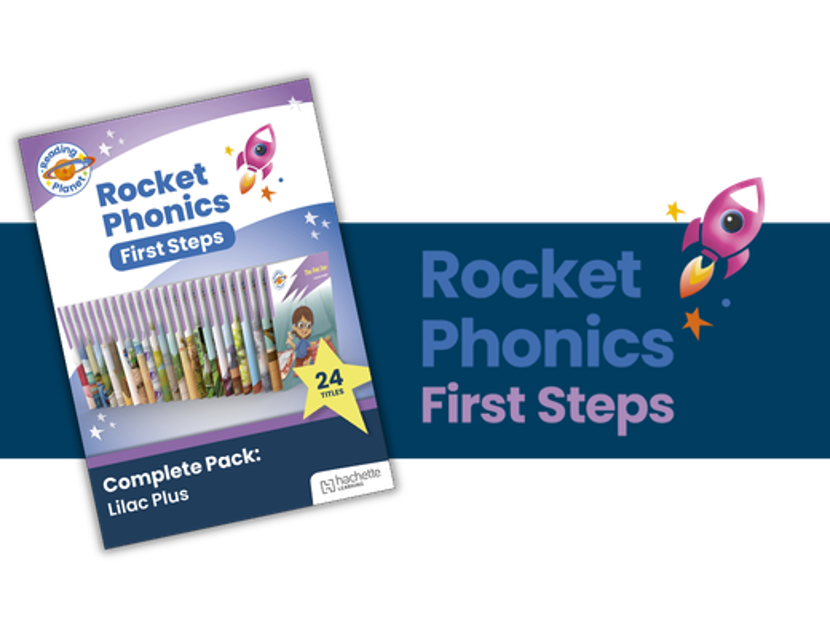
To ensure that the phonics curriculum is adapted to the needs of the children and not vice versa, the schools split their pre-school cohort into two smaller groups based on their speech and language acquisition. This is informed by staff observations and data from other tools such as WellComm and ensures that children’s needs are fully supported. Practitioners at the schools said that the Rocket Phonics First Steps ready-made lesson plans are a valuable support. “I would say we follow the lesson plans closely. I try to touch on all the aspects. They’re really useful and a good structure,” says Tally. The 15-20 minute daily phonics session is lively, practical and interactive, with the teacher or TA using puppets, flashcards and the IWB, as suggested in the lesson plans. The ‘sounds’ are reinforced through multisensory activities set out in the classroom for children to access independently throughout the day. This helps to embed the learning in children’s long-term memory and develops their fine motor skills through a range of tactile resources like playdough. Both wordless and fully-decodable reading books are shared in various ways: in 1:1 interactions with the children, through guided reading sessions, and sent home for parents to share with their child.
Above all, learning must be joyful and fun. All three schools rated children’s enjoyment of the programme very highly, agreeing that pupils love the ditties for the sounds and the big books that show the sounds within stories. “They love the big books,” says Sian, “they really want to know what happens next as you progress through the story.” Tally, describing her pupils’ reactions, says, “When I use the interactive flashcards, they’re eager to show what they know, and to learn the new sounds.” And it’s not only staff who’ve picked up on children’s excitement and engagement during phonics sessions: improvement officers visiting the schools have commented on ‘the joy of phonics and teachers’ enjoyment when teaching it’, says Sian. Improvement officers have also praised children’s positive attitude to learning, which is reflected in their confidence and resilience as learners.
When asked to describe whether adopting Rocket Phonics First Steps has been the right decision for their schools, practitioners across the settings described a range of benefits to them and their pupils.
Developing staff practice and boosting their confidence. The quality and user-friendliness of the programme’s resources is particularly valuable for support teachers with less experience. “Our Nursery teacher is very experienced but for staff who’ve moved into Early Years from older year groups, the resources and CPD have been a huge support,” says Sian.
Supporting children’s development of speech sounds. Because sounds are introduced progressively in the order of natural speech development, staff can quickly identify children who need more support, prompting agile and timely interventions. “I’ve seen an impact already with children who need support around the pronunciation of some sounds,” says Tally.
Boosting children’s confidence in speaking and writing. Adopting a child-centred programme means that children are more likely to succeed – and see themselves as successful learners. “The way it’s developed their speech confidence is huge,” says Sian.
Developing a love of reading and books. For children who’ve come from homes without books, it’s a crucial part of the setting’s Reading for Pleasure culture. “They’ve enjoyed the books so much. We have children arriving who’ve not had books at home, but very quickly they develop a love of reading because of their immersion in the programme,” says Sian.
For schools unsure whether introducing a structured phonics programme into their pre-school provision is right for them, Sian reflects on her own experience. "From my experience in schools where phonics was not introduced at the nursery stage, the difference is striking. Establishing a phonics programme early on is an obvious choice to give our pupils a flying start… … I don’t know why you wouldn’t do it."
Curriculum changes. New materials. Price discounts and unmissable offers. We’ll make sure you don’t miss a thing with regular email updates, tailored by subject and age group.

