Sign in for a more personalised experience
Unlock a more personalised experience to discover special offers, suggested products and more!
Sign inDon’t have an account? Click to sign up today!Rocket Phonics Impact Trial 2021-2023 Summary
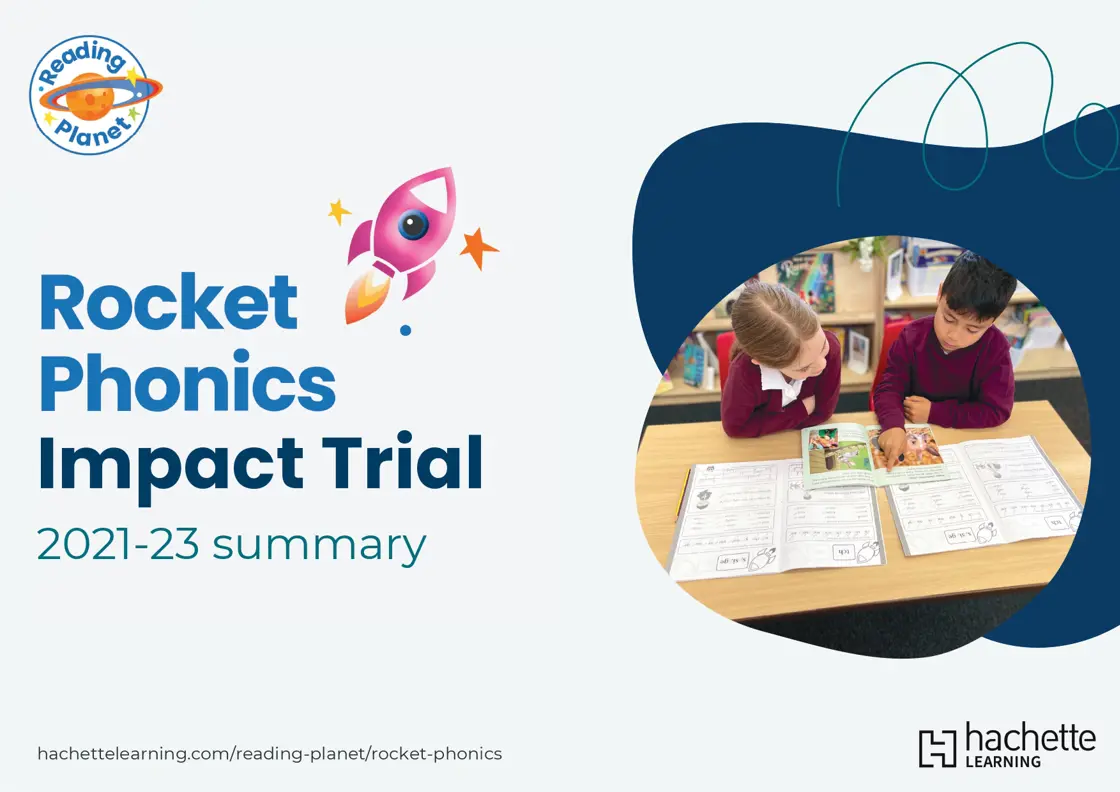
In 2021, we launched a two-year Impact Trial working with two independent evaluators (Professor Clare Wood, Nottingham Trent University and Dr Helen Breadmore, Associate Professor Psychology in Education, University of Birmingham) to measure the impact of the programme on pupils' reading attainment.
Extensive evidence captured from qualitative and quantitative trials carried out by independent research institutions indicates that Rocket Phonics is a well-liked, easy-to-use programme which is effective in teaching and embedding the phonics skills children need to become successful readers.
Report Highlights
-
Pupils using Rocket Phonics, including those starting Year 1 with very low phonics knowledge, saw a rapid and measurable increase in phonics knowledge.
-
Despite higher percentages of PP and EAL children in schools using Rocket Phonics, pupils’ attainment was in line with control schools and spelling appeared slightly better, based on average pre- and post-trial standardised test scores.
- Compared with those using other SSP programmes, teachers’ attitudes towards teaching phonics were far more positive amongst Rocket Phonics schools.
- Independent observational evidence indicated that children and teachers enjoyed their phonics lessons, and children engaged well with the Rocket Phonics resources they used.
Introduction
According to the most recent PiRLs (Progress in International Reading Literacy Study, 2021), pupils in England are amongst the most proficient readers in the world. In this assessment for 10-year-olds, England was ranked fourth out of all participating countries, its highest position since the study began in 2001. This is testament to the commitment and hard work of Early Years and primary school teachers, and to the continued focus on systematic synthetic phonics (SSP) as the dominant reading strategy for teaching reading. Indeed, one of the strongest predictors of PiRLs performance was pupils’ Year 1 phonics screening check result: those who meet or exceed the required standard in phonics are highly likely to become successful and confident readers.
Although the PiRLs results are extremely encouraging, they don’t tell the whole story, and particularly since the Covid-19 pandemic, children’s performance in Early Years Foundation Stage assessments and in the Year 1 phonics screening check has faltered and not yet returned to pre-pandemic levels (DfE October 2023, November 2023). Furthermore, children’s enjoyment of reading has declined significantly since the pandemic, falling to its lowest level in 2023 (National Literacy Trust report: Children and young people’s reading 2023); and much is still to be done to close the socio-economic attainment gap, particularly in reading (EEF/NFER 2022).
As part of the drive to raise literacy standards for all pupils, in 2021 the DfE invited publishers to submit SSP programmes for validation. These programmes were initially self-assessed on a range of criteria set out by the DfE and then submitted for validation by a panel selected by the DfE. Rocket Phonics, published by Hodder Education as part of the Reading Planet suite of reading resources, was successful in receiving validation in the first round of the process.
The Rocket Phonics programme draws on the most upto-date practice and research into phonics instruction, and was developed following an iterative process of trialling in schools prior to publication. It was written by phonics and literacy expert, Abigail Steel, in consultation with Debbie Hepplewhite MBE, a renowned advocate of SSP.
The Rocket Phonics SSP programme is notable for combining a rigorous approach to teaching phonics with nurturing a love of reading through its unique interactive ‘Big Books’ that present the letter-sounds within the context of engaging stories, and its engaging, fully decodable Target Practice Readers that enable children to practise decoding skills in full alignment with the programme.
Read the full impact trial statistical analyses and process evaluation reports
Hear from us
Curriculum changes. New materials. Price discounts and unmissable offers. We’ll make sure you don’t miss a thing with regular email updates, tailored by subject and age group.