Sign in for a more personalised experience
Unlock a more personalised experience to discover special offers, suggested products and more!
Sign inDon’t have an account? Click to sign up today!New guide for the IB Extended Essay
Introduction
As someone who has served as an EE coordinator, examiner, and supervisor, I’ve grown deeply familiar with the previous incarnation of the Extended Essay. Like many of you, years of accumulated experience have made supporting students through the process feel second nature.
However, change is on the horizon. As the final cohort taking the previous version of the EE moves toward the end of the process, it’s increasingly important for us to engage with the upcoming updates. I am in the privileged position of having had early access to the new guide and thus more time to focus on the changes. Through these posts, I’m going to share insights and ideas that will help guide your understanding along, as well as give a taste of what is available in the recently published textbook from Hachette Learning.
Summary of major changes
This is an exciting moment for the EE. The last major revision, back in 2018, already feels like a product of a very different educational landscape. Whether we consider technological upheaval such as the rapid evolution and availability of AI, the continuing development of pedagogical theories and practices, or global events that have had enormous repercussions in the classroom and beyond, it is clear that the context in which students learn is continuing to change at a rapid pace. In response, the Extended Essay is evolving to remain aligned with the IB’s mission: to develop inquiring, knowledgeable, and caring young people who are prepared to navigate—and contribute to—a complex and rapidly changing world.
If I were to characterise the broad changes made, I would say they are an evolution rather than a revolution of the EE. They are in the direction of flexibility rather than rigidity, easing away from prescriptive rubrics and overly defined categories that can sometimes limit students’ inquiries.
A few of the major changes coming are summarised below.
|
Previous version |
May 2027 onwards |
|
|
Total number of marks is 30 |
|
Criterion C ‘Critical thinking’ marked out of 12 |
Split into Criterion C ‘Analysis and line of argument’ marked out of 6 and Criterion D ‘Discussion and evaluation’ marked out of 8 |
|
Criterion D ‘Formal presentation’ marked out of 4 |
Merged into Criterion A ‘Framework for the essay’ as the strand ‘structure’ which contributes to a total mark out of 6 for the criterion |
|
Criterion E ‘Engagement’ marked out of 6, based on three written reflections produced after each of the corresponding three mandatory reflection sessions on the Reflections on Progress and Planning Form (RPPF) |
Criterion E ‘Reflection’ marked out of 4, now based on one reflective statement written on the Reflection and Progress Form (RPF) after the viva voce, with a focus on the growth of the learner and an emphasis on skills development and transfer |
|
World Studies Extended Essay (WSEE) for exploring complex global issues through an interdisciplinary lens |
World Studies Extended Essay (WSEE) for exploring complex global issues through an interdisciplinary lens A new Interdisciplinary Pathway for the EE allowing for more flexibility in how subjects are combined |
Further changes beyond those listed above have been made and are explored in the textbook, such as the new student-friendly style to the guide, the new document of support materials, and various tweaks to the specific subject areas of the EE. There is also more clarity around academic integrity and integration of AI, something that will also be expanded on in a future blog post.
The Change that Excites Me Most
The change I am most excited by is what I consider the ‘big idea’ of the new revision of the component: the interdisciplinary pathway.
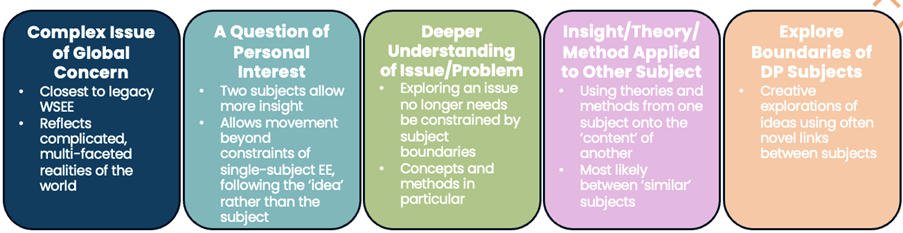
In many ways, it is an expansion of the possibilities afforded by the previous version’s World Studies EE. While the WSEE was more specifically focussed on an issue of ‘contemporary global significance’ and had various requirements such as a local and global context, the new interdisciplinary pathway for the EE affords more range in a student’s inquiry.
The pathway opens up far more opportunities for interesting research questions that combine subjects in new and exciting ways. Students now have more flexibility in combining subject lenses by drawing upon any relevant knowledge, concepts, theories, perspectives and/or methods from each of their two chosen subjects. Consequently, they can now use two subject lenses on more varied research questions that previously fell outside the scope of a WSEE.
Below are the five main reasons students may take the new interdisciplinary pathway.
Further details can be found in the newly published Hachette Learning textbook, and I’ll be exploring the interdisciplinary pathway in greater depth in an upcoming blog post.
Future Blogs
That brings this post to a close, but look out for future blogs. I am looking forward to covering the following in the coming weeks:
Hear from us
Curriculum changes. New materials. Price discounts and unmissable offers. We’ll make sure you don’t miss a thing with regular email updates, tailored by subject and age group.