Sign in for a more personalised experience
Unlock a more personalised experience to discover special offers, suggested products and more!
Sign inDon’t have an account? Click to sign up today!Introducing Adaptive Learn: personalised practice for every Cambridge learner
 Adaptive Learn delivers a learning journey as unique as your learners, combining personalised digital practice with actionable insights for educators. Powered by adaptive technology and grounded in metacognition, it offers a learning experience that grows with each child – building confidence, independence, and wellbeing along the way.
-
Content as unique as your learners.
The future of learning has arrived for Cambridge Primary with personalised digital practice for learners and actionable insights for educators.
-
Technology that adapts to each learner.
Adaptive technology offers a truly unique learning experience that analyses and adapts to each learner’s accuracy and confidence, nurturing strengths and targeting gaps.
-
Driven by metacognition.
Build learner confidence and autonomy through metacognitive awareness, encouraging learners to: Reflect on their learning strategies, Monitor their own progress, Make adjustments along the way.
-
Supports wellbeing.
With built-in ‘check-ins’ and termly ‘snapshots’ to support social, emotional, academic and physical wellbeing.
All of the features and benefits above can now be accessed by schools with courses in English, Maths, Science and Computing for Cambridge Primary (Stages 1 to 6) and Cambridge Lower Secondary (Stages 7 to 9).
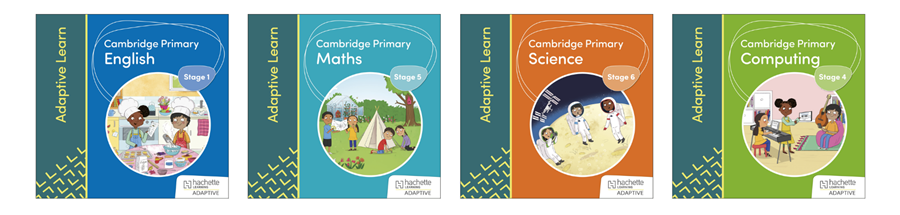
As a Cambridge partner for 35 years, with a deep understanding of the needs of Cambridge schools worldwide, we have mapped the Adaptive Learn materials to our Learner Books, which have been endorsed for the Cambridge Pathway. This means that you can use these resources alongside our physical books, or they can stand alone as independent practice for learners. Either way, they will fully support your Cambridge curriculum.
- We believe that every learner should have the opportunity to thrive. And that education should start by recognising the needs of individuals first.
- Our mission is to help every learner reach their unique potential, by empowering those who teach them.
Behind the Scenes: How Adaptive Learn was built
We take time to understand our customers and work closely with educators, learners, academics, awarding bodies and partners to develop our solutions.
We're really proud of the resources we've created; they're evidence based, and founded on research with real schools, teachers and learners' needs and aspirations. We partnered with a number of schools who trialed our resources through the early phases of development, giving feedback on what they liked and didn't like. We are also currently undertaking impact trials with the finished resources and will share evidence of academic impact once this is complete.
But don't just take our word for it! Read our first Adaptive Learn case study from The Concord School in Nigeria, and read some of the things that our trial schools had to say about the platform:
“Our teachers are really happy compared to other resources we’ve used before, because of the Cambridge focus… there’s nothing else like this that focusses as much on our curriculum.” Ms Celiberti, St Constantine’s School, Tanzania
“Adaptive Learn was highly impactful in enhancing our teaching and learning approaches. This platform has been invaluable in supporting teachers while actively engaging students in their learning.” Ms Acera-Ducoyan, Bangkok Bilingual School, Thailand
Unboxing the resources: What does "adaptive technology" really mean?
In the context of Adaptive Learn, adaptive technology is what underpins the ‘My Practice’ tasks, which can be assigned to learners for homework or independent study. You can think of these tasks as a bit like a digital workbook. There’s a My Practice assignment for every unit and topic within each course. The questions within the assignments are also tagged to the Cambridge learning objectives, so you can be assured that the full curriculum is covered.
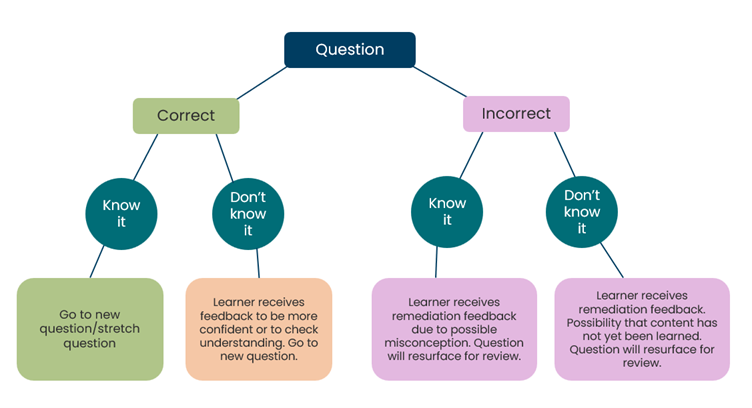
The difference between this, and a physical workbook, or even a traditional digital quiz, is that adaptive learning automatically adjusts to the needs of each learner. When a learner answers a question, they will either get it right (yay!) or wrong (keep trying!) which tells the system whether to offer stretch or support questions. In addition to this, learners are prompted to rate their confidence level (Know it, Think I know it, Not sure, or Don't know it) – this measures learner metacognition and also indicates to the system whether the learner has guessed the answer, has a misconception, or isn’t confident in their answer (despite getting it right). These two inputs (answer and metacognition), plus time taken, are what prompts new questions to be generated according to the learner’s need. Much like a personal tutor, Adaptive Learn tailors content to the individual learner and provides instant feedback. No two students will take the same learning path.
But all of this isn't happening in a vacuum. Teachers can keep up with learners’ homework status in the Reports dashboard. Here, they will also see the learning objectives that learners are struggling with most to help plan their lessons. Metacognition data is also available here, so teachers can see on an individual and class level, what proportion of learners were aware that they knew the right answer and what proportion weren’t.
‘Thinking about thinking’: What is metacognition?
At Hachette Learning, we know that learning isn’t just about learners getting answers right, it’s also about understanding why and how they got it right. Metacognition (or ‘thinking about thinking’) is a fundamental part of Adaptive Learn, both in terms of how the technology works, and in its pedagogical principles. When learners answer questions, they are also prompted to rate their understanding i.e. Know it, Think I know it, Not sure, Don’t know it, giving them an opportunity to pause and think about whether they understood how they arrived at the answer, and why. This not only removes the tendency towards mindless click-based learning, which often occurs in other digital resources, but it can also indicate whether a learner is guessing at an answer, has a misconception, or (ideally!) is secure in their understanding. All of this information is fed back to the educator dashboard, so that teachers and leaders can gain insights into their cohorts’ levels of understanding and act accordingly.
For more information on metacognition, read this brilliant article by Anoara Mughal, metacognition specialist.
What are the actionable insights?
In plain language, actionable insights are findings - usually from data, research, or analysis - that are specific, clear, and practical enough to drive a decision or behaviour change. In other words, they give you information on what to do next, not just what is happening.
In Adaptive Learn, we have developed a powerful and easy to use Reports area, where teachers and school leaders can access real-time data on their classes and individual learners progress, understanding, wellbeing and gaps in learning. Through a variety of visual reports, with an array of filtering options, you can access information on:
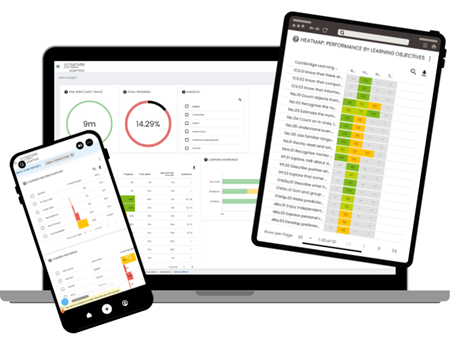 Which learners need the most support
- The percentage of learners who were ‘aware that they knew the answer’ and the percentage that didn’t
- The overall levels of wellbeing for a class and for individual learners
- Learner progress by assignment
- A heatmap showing performance by Cambridge learning objective
- An ‘at a glance’ view of the Cambridge learning objectives which most learners struggled with
And what’s more, learners can also access child-friendly reporting in their own dashboards to encourage learner self-reflection and for parent/carer insights.
How does the resource support learners' wellbeing?
Wellbeing is a priority in all schools. Empirical data consistently shows that learners who experience positive wellbeing achieve greater academic success and enjoy a higher quality of life. However, supporting wellbeing effectively is challenging, as the difficulties learners face are often unique to their individual settings. A one-size-fits-all approach cannot fully address the specific needs of different school communities.
Without a clear understanding of learners’ experiences, schools risk implementing generic strategies that fail to address the real issues at play.
This is why assessing learner wellbeing is essential. In Adaptive Learn we have developed two types of wellbeing questionnaire:
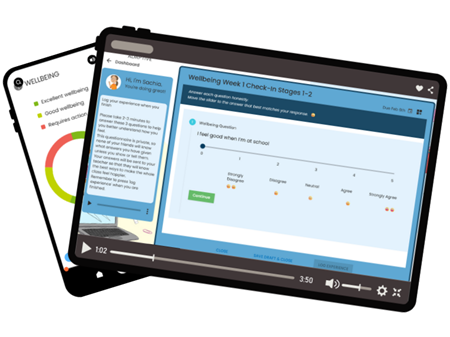 Wellbeing Check-ins – for quick ‘temperature’ gauges on whether learners are ready to learn on any given day, and to encourage learners to think about their wellbeing on a regular basis
- Wellbeing Snapshots – more detailed surveys which look at all aspects of learner wellbeing (social, academic, physical and emotional) on a termly basis to build up a picture of whole class and individual wellbeing over a period of time
By gathering insights into the pressures learners face, schools can tailor their support both across year groups and on an individual level and ensure good use of teacher time and resources. A well-informed approach ensures that interventions are meaningful, targeted, and effective.
You may ask: Is it really safe for children to be using screens in their learning?
We know that in today’s world children are exposed to screens and digital content more and more in their everyday lives. That’s why we understand the importance of keeping children safe in their learning. Adaptive Learn has been developed using a secure platform used by many schools, which adheres to strict data protection standards. It protects children’s personal information and does not allow public chatting or unsafe content. Learners will only use it with their school login.
We also understand that sometimes parents (and educators) may be unsure about digital homework and associated screen time. Adaptive Learn is designed for focused, short bursts of learning, not mindless clicking. It encourages active engagement, not passive consumption and is based on robust pedagogical principles and fully aligned to the Cambridge curriculum. It makes it easy for parents to monitor their child’s progress and confidence levels through the learner dashboard.
We would also always encourage schools to balance digital learning with physical textbooks and manipulatives, and of course Hachette Learning offers materials for all of the Adaptive Learn course, which can be used alongside them, including: Teacher’s Guides, Learner’s Books and Workbooks.
And what’s next?
Watch this space for Adaptive Learn for Lower Secondary, stages 7, 8 and 9 launching in April 2026, and new features and subject areas in the pipeline!
Written by Hamish Baxter, Senior Lead Product Manager at Hachette Learning
*please note, Adaptive Learn has not been through the endorsement process for the Cambridge Pathway.
Discover Adaptive Learn
Driven by metacognitive learning and adaptive technology
Help every learner to realise their unique potential with activities and pathways that adapt to each learner's accuracy and academic confidence.
Develop healthy independent learning habits and support wellbeing with weekly 'Check-ins' and termly 'Snapshots'.
Gain real-time data insights into your learners' progress and wellbeing.
Featured products
Hear from us
Curriculum changes. New materials. Price discounts and unmissable offers. We’ll make sure you don’t miss a thing with regular email updates, tailored by subject and age group.