Sign in for a more personalised experience
Unlock a more personalised experience to discover special offers, suggested products and more!
Sign inDon’t have an account? Click to sign up today!Hachette Learning Academy's Competency Framework

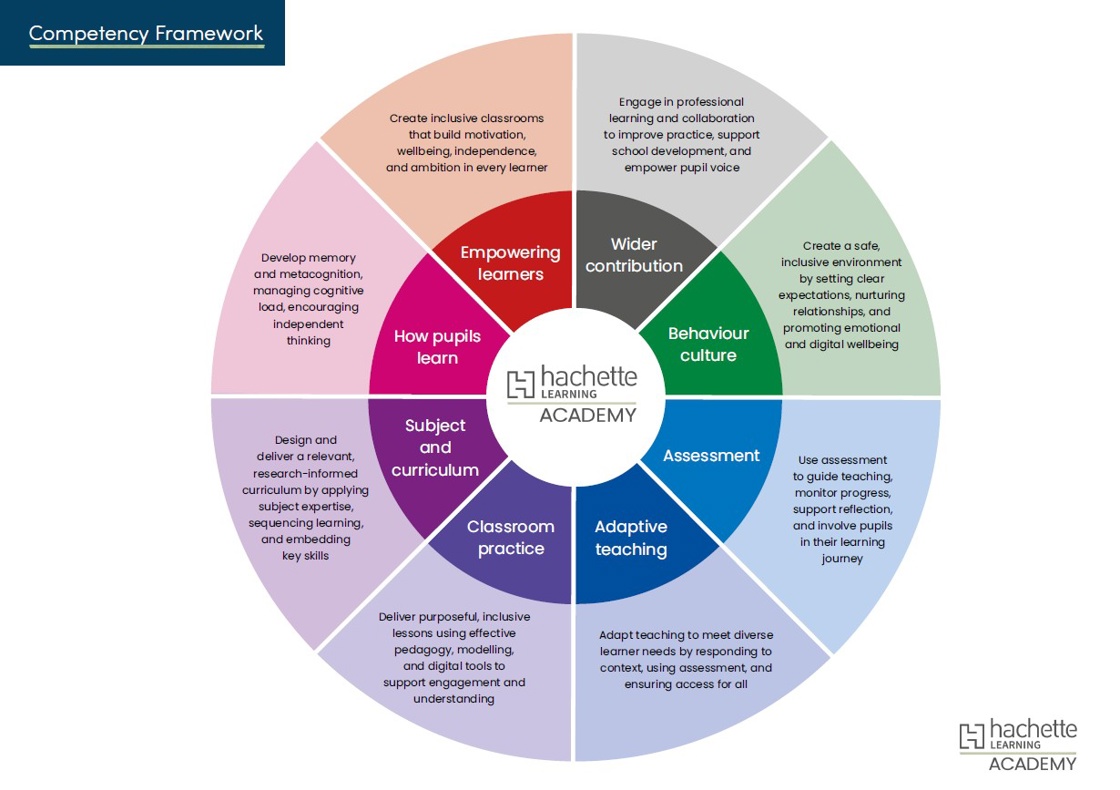
Hachette Learning Academy’s online courses support in-demand, contemporary themes for teachers such as oracy, digital literacy and wellbeing, and support for students with English as an Additional Language (EAL). Powered by adaptive learning technologies, these courses are designed to help teachers develop their expertise in line with their own pace of progress.
Our courses are commissioned with a teaching competency framework at the front and centre, to ensure the strongest outcomes in terms of upskilling and career progression.
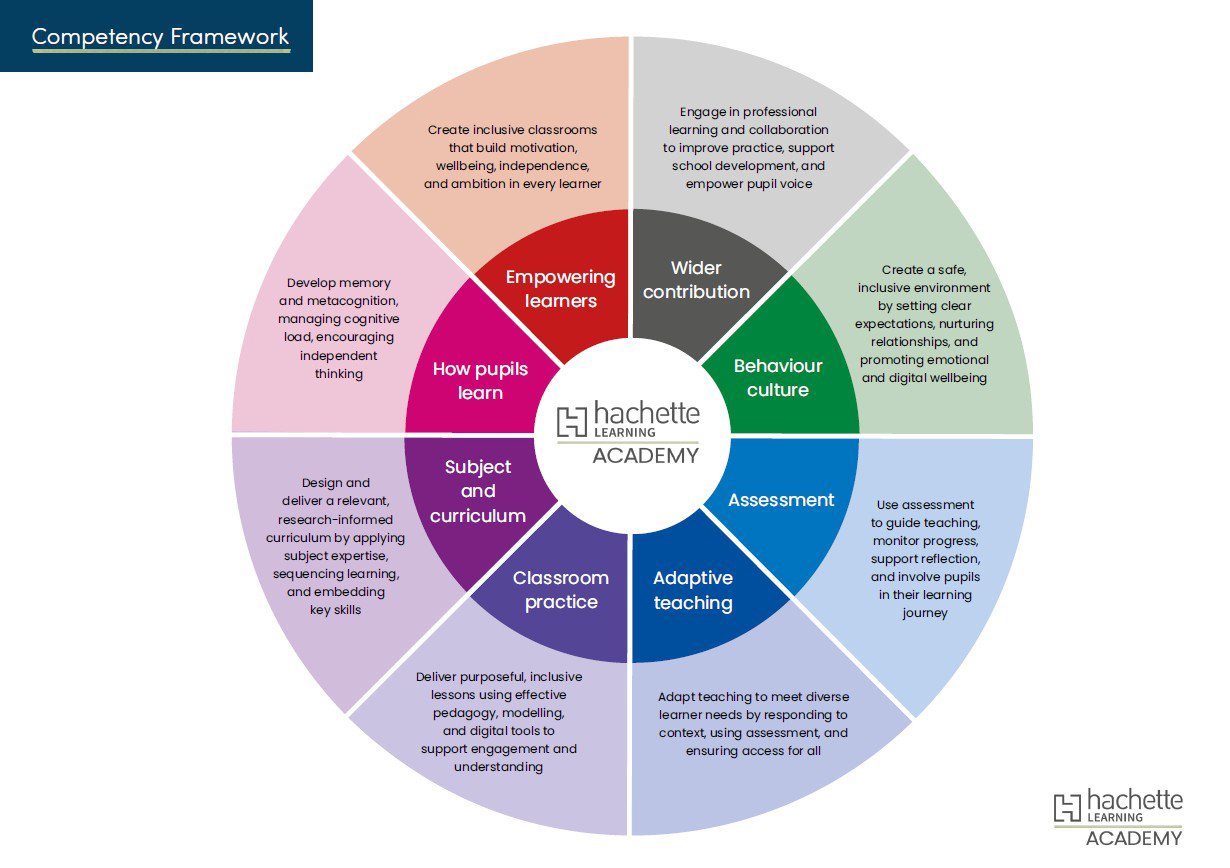
You can view the full competency framework and more details about how the courses fit into each competency here.
What is the teaching competency framework?
The teaching competency framework encapsulates the knowledge, skills and professional behaviours expected of teachers. It brings clarity and direction to professional development by giving schools a structured way to understand and plan for staff growth.
It can align with national teaching standards, other recognised frameworks and your own school’s PD strategy, making it easier to design a plan for professional development that truly fits your context.
How might leadership staff and teachers use the competency framework?
- Leaders can use it to select courses and plan PD that aligns with whole-school priorities.
- Teachers can engage in practical and reflective tasks linked to their practice, track learners’ responses to their activities in their personal portfolio and track their progress towards their own professional goals through their learner dashboard.
- PD leads and senior management teams can monitor competencies across individuals or groups, creating a coherent, joined-up approach to planning and evaluating CPD.
Our online courses help to build these competencies through responsive technology and content from our expert, internationally-renowned authors.
If you would like to learn more about how this framework can align with your existing standards or strategy, a member of our sales team will be able to help you.
1. Which Hachette Learning Academy courses cover how pupils learn?
The courses we first commissioned focus around the principle of metacognition. These courses help teachers develop learners’ memory and self-learning skills, encouraging them to think independently and manage cognitive load. These courses have since been expanded on by other authors around the world and include:
- How learners learn: strategies for high-impact teaching
- The power of practice: strengthening learning in the classroom
- Presenting content for effective learning
- Thinking about thinking: Developing metacognition in the classroom
- Revolutionising Revision: empowering every learner to study effectively and achieve success
2. Which Hachette Learning Academy courses deal with empowering learners?
At the heart of what we do is the idea of inclusive classrooms that build motivation, wellbeing, independence and ambition in every learner. Our courses that help with this competency currently include:
- Supporting student wellbeing
- Independence and self-belief: helping every learner thrive
- Creating an inclusive classroom
- Social-emotional literacy in action: Building connected and collaborative classrooms
3. Which Hachette Learning Academy courses support subject and curriculum?
We are building up our courses designed to support teachers with EAL student in mainstream classrooms, and moving from digital competency to digital agency, with courses such as:
- Oracy in action: Strategies to support EAL learners
- Building vocabulary: Strategies to support EL learners
- Teaching for digital fluency
- Developing oracy: Building confident voices and active listeners
- Developing research skills in the secondary classroom
- Developing writing skills in the primary classroom
- Developing writing skills in the secondary classroom
4. Which Hachette Learning Academy courses cover classroom practice?
This competency includes delivering purposeful, inclusive lessons using effective pedagogy, modelling, and digital tools to support engagement and understanding. Courses that cover these themes include:
- Using questioning for impact
- Scaffolding for success: Strategies to support EAL learners
- Inquiry-based learning: Engaging students through exploration and critical thinking
- Instruction-based learning: Effective classroom delivery
- Effective lesson planning: sequencing for learning progression
- Effective scaffolding: From explanation to independence
5. Which Hachette Learning Academy courses focus on making a wider contribution?
Our hope is that educators will engage in professional learning to improve practice, support school development and empower pupil voices. To support this goal, we have commissioned courses specifically aimed at supporting teachers and contributing more widely to topical issues that affect educators and pupils:
6. Which Hachette Learning Academy courses address behaviour and culture?
It feels more important than ever that educators, where possible, can create a safe, inclusive environment by setting clear expectations, nurturing relationships, and promoting emotional and digital wellbeing. Our new course, Digital wellbeing: Practical strategies to support learners is full of actionable lessons that teachers can put into practice, as is Behaviour for Learning: Developing effective approaches.
7. Which Hachette Learning Academy courses support assessment?
As we all know, assessment is key for guiding teaching, monitoring progress, supporting reflection, and involving pupils in their learning journey. These goals are supported by our courses:
- Making Learning Visible: Learning Intentions and success criteria
- Feedback for Impact
- Adaptive and inclusive assessment: practices to support all learners
- Turning data into insight and action: using assessment data effectively
- Formative assessment: Supporting student progress
- Summative assessment: Supporting student success
8. Which Hachette Learning Academy courses focus on and support adaptive teaching?
Our courses are powered by educators who feel passionate about adaptive learning, and have thought long and hard about what it means and how it can be applied. Our courses are designed to help teachers take their adaptive learning to the next level, and include:
- Adaptive teaching: Challenge and progress
- Social and academic proficiency: strategies to support EAL learners
- Supporting neurodivergent learners
Want to learn more?
Our Sales Consultants will be able to outline for you how our online courses can be mapped to and interpreted in the context of recognised standards such as:
- Professional teaching standards from the Department of Education
- OECD high-quality teaching practices
- Cambridge International Teacher Standards
Find out more about our courses and order a 20-minute trial online. You can also get in touch to discover how Hachette Learning Academy can take your professional development to new heights, by email to education@hachette.co.uk or by calling 01235 827 720.
Hear from us
Curriculum changes. New materials. Price discounts and unmissable offers. We’ll make sure you don’t miss a thing with regular email updates, tailored by subject and age group.