Sign in for a more personalised experience
Unlock a more personalised experience to discover special offers, suggested products and more!
Sign inDon’t have an account? Click to sign up today!AQA A-level Psychology Year 2 is published - we want your feedback!
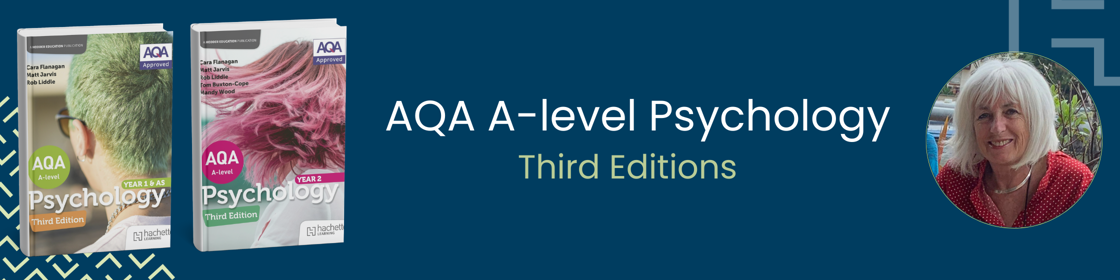
The Year 2 book is publishing this week. Hooray! As with our Year 1 book, the new 3rd edition may look very much like the 2nd edition but the final product does not reflect the intense activity required to create it. A large team of authors and reviewers have checked every word in the book multiple times, revising the text for clarity, accuracy and sensitivity. We have added new material where the specification required it and we have again created a new evaluation point on every spread. We strive to produce a textbook that is a joy to read, putting a lot of thought into our illustrations as well as the overall layout to make the spreads look inviting.
The importance of layout
I have been writing psychology textbooks for more than 30 years. From the start, I believed that layout was critically important. Almost all textbooks are presented in a linear fashion but I felt that a magazine-style layout was more attractive to a reader and also helped to make the topic more coherent because it was all there in one ‘picture’.
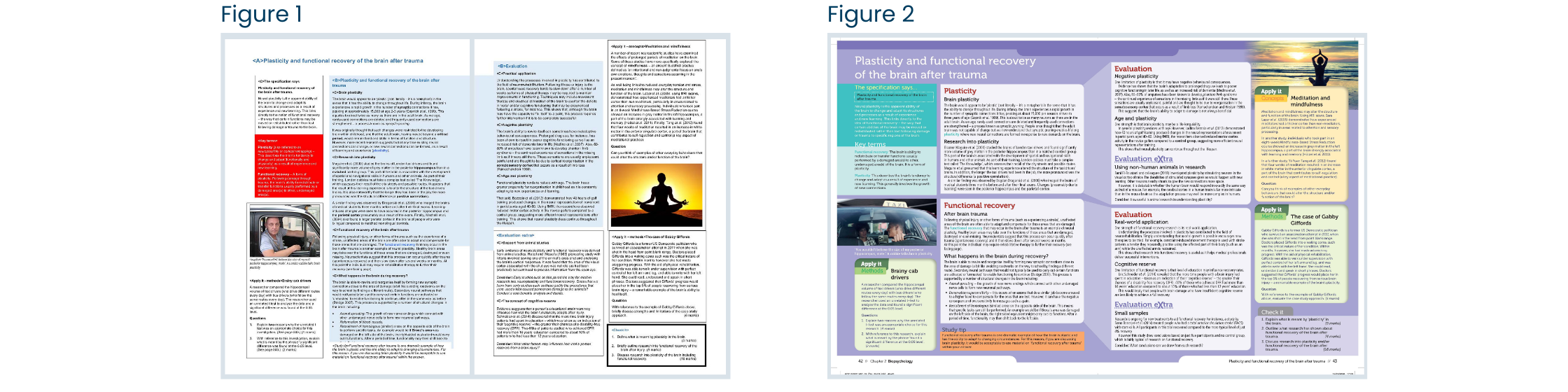
We spend a lot of time designing each spread so it is a thing of beauty. The process starts with a Word document (see Figure 1). We set it out in Word so we can be certain that the text and illustrations will fit exactly on the spread. Then our incredible designer (Sarah Clifford) translates the Word document into a fully-designed spread (see Figure 2). The two figures are different in many ways, for example we continue to edit the text once the content is in pdf form. Nic Watson, our superb editor, raises queries and improves the text, and various other reviewers provide suggestions for sensitivity and readability.
How do we decide what goes on each spread?
Each spread relates to one potential essay question and aims to provide 16 marks’ worth of content: 6 marks of description (AO1) and 10 marks of evaluation (AO3). We actually provide more AO1 than necessary for an essay to address other possible descriptive questions. We also provide practice for application questions in the Apply it activities on the spread.
You may wonder, in the example spreads above, why we sometimes cover two topics on one spread. We check past exam papers to identify those topics that are unlikely to be selected for a 16-mark essay – plasticity and functional recovery have never been separate topics in the 16-mark essays.
Tell us what you think of the 3rd editions
We love getting feedback from both teachers and students, and the more specific the better, so we can act on it. We really do want to know what people like and don’t like, and whether anything needs adjusting or rethinking. We don’t want you (and your students) to sit there puzzling over something in the book or in Boost or even something in the specification. For this reason, we have set up a private Facebook group for teachers (Green and Pink Hair books (AQA A level Psychology). I monitor the group along with Jo Haycock who oversees the content on Boost. If comments come directly to us, we can offer some explanation or make changes to the text.
Of course, many people do write directly to Hachette, usually in relation to errors in the textbooks rather than about more general concerns or thoughts. The Hachette comments/queries also come to us but the Facebook page allows us to share our responses with everyone. The address to use for Hachette is: www.hachettelearning.com/contact-us
More information on all of the resources available for the revised AQA A-level Psychology specification can be found on our green-and-pink-hair series page, or by selecting individual products below.
Look out for future blogs on AQA A-level Psychology over the coming weeks.
Featured products
Hear from us
Curriculum changes. New materials. Price discounts and unmissable offers. We’ll make sure you don’t miss a thing with regular email updates, tailored by subject and age group.