Sign in for a more personalised experience
Unlock a more personalised experience to discover special offers, suggested products and more!
Sign inDon’t have an account? Click to sign up today!A look at the 2025 GPS SATs
In March 2025, the Interim Curriculum Review outlined that the Call for Evidence has highlighted some concerns with assessments. Concerns were around the standalone Key Stage 2 assessment on grammar, punctuation and spelling and how it may lead to the teaching of textual features in isolation at the expense of a sound understanding of reading and writing.
As we await the Curriculum Review, we wonder what will happen with the Key Stage 2 GPS test since the Interim Report stated: ‘we will review the curriculum and how this assessment might better equip pupils to use these foundational building blocks fluently.’
But for now, we can look at the 2025 test to support identifying implications for whole-school teaching as we enter a new academic year.
In 2025, 73% of pupils met the expected standard for GPS (which is up from 72% in 2024). The average scaled score for GPS is 105 – this remains unchanged since 2021. Pupils needed a raw score of 35/70 (50%) to achieve the scaled score of 100 and 54/70 (77%) to gain 110+.
A summary of content distribution in papers:
|
|
G1 |
G2 |
G3 |
G4 |
G5 |
G6 |
G7 |
|
|
Grammatical terms or word classes |
Functions of sentences |
Combining words, phrases and clauses |
Verb forms. Tenses and consistency |
Punctuation |
Vocabulary |
Standard English and formality |
|
% of questions in 2025 |
26 |
6 |
10 |
14 |
30 |
8 |
6 |
|
% of questions in 2024 |
24 |
6 |
8 |
12 |
32 |
12 |
6 |
|
% of questions in 2023 |
24 |
8 |
8 |
12 |
32 |
10 |
6 |
GPS is a whole-school issue
Paper 1 traditionally has 50 questions which get progressively harder throughout the paper – the later questions are more challenging than those earlier.
Below is a brief analysis from the final 10 questions in 2025’s Paper 1:
|
Question number |
Content domain/ reference |
Type of question |
Year group this is first introduced |
|
41 |
G3.2 |
Insert a noun phrase at the beginning of a sentence… |
Y2 |
|
42 |
G5.2 G5.1 |
Insert missing full stops & capital letters into a passage… |
Y1 |
|
43 |
G4.4 |
Rewrite the sentence in the active… |
Y6 |
|
44 |
G1.5a |
Circle the possessive pronoun… |
Y4 |
|
45 |
G1.4 G3.4 G3.3 |
Circle all the conjunctions in a passage… |
Y1 (and) Y2 (co-ordinating & sub-ordinating conjunctions) Y3 – ‘conjunction’ |
|
46 |
G4.3 G7.4 |
Circle the verb in the subjunctive… |
Y6 |
|
47 |
G1.8 |
Circle three determiners in the passage… |
Y4 |
|
48 |
G4.1d G7.4 |
Insert a verb using the past progressive… |
Y2 |
|
49 |
G1.6 |
Circle the adverb in the sentence… |
Y2 |
|
50 |
G4.1b G1.2 |
Complete the sentence using the past perfect… |
Y5 |
It is clear to see that although these are the 10 most demanding items in the paper, the content of these questions covers learning that is first introduced in Years 1; 2; 3; 4 and 5.
This demonstrates that when content is introduced in younger year groups; the following year groups need to both review previous learning and extend the learning further. Although full stops and capital letters are the ‘bread and butter’ for Year 1 children (and their teachers) it would be wholly inappropriate to give year 1 children question 42 to complete. What we can see here is learning first introduced in Year 1 but tested with an understanding that the pupils have had another 4 years teaching where their learning has been further developed.
This implication goes beyond the Key Stage 2 GPS test and instead encompasses the whole National Curriculum for English including the appendices. Many schools have purchased commercial schemes that teach ‘English.’ 2025–2026 could be the year that your school revisits the English National Curriculum at its organic stage and reflects/evaluates whether you have fidelity to the National Curriculum or a bought in scheme. It is important to recognise that many published resources can support schools to have a consistent approach to teaching and ensure progression from year group to year group. More importantly, by revisiting the document that is statutory for education, you and your team may identify areas that you could need CPD or a resource (whether that is at the planning stage or indeed to ensure reliable and rigorous internal data.)
Maddy Barnes, August 2025
Maddy has over 18 years' experience as a Teacher and Assistant Head, before taking on her current role as Executive Director of English at Three Saints Trust.
Follow @MoonMaddy on X or connect on LinkedIn.
Measure understanding with assessments
Benchmark attainment and track progress with full national curriculum coverage. Following the National Test framework and designed to reflect SATs papers in format, content and demand, New GaPS helps to familiarise learners with National Test-style assessments while providing key insights into learning gaps and areas of excellence at individual, group and school levels.
Plus, unlock next-step interventions with Shine GPS, generating targeted activities based on your New GaPS results.

Get set for success
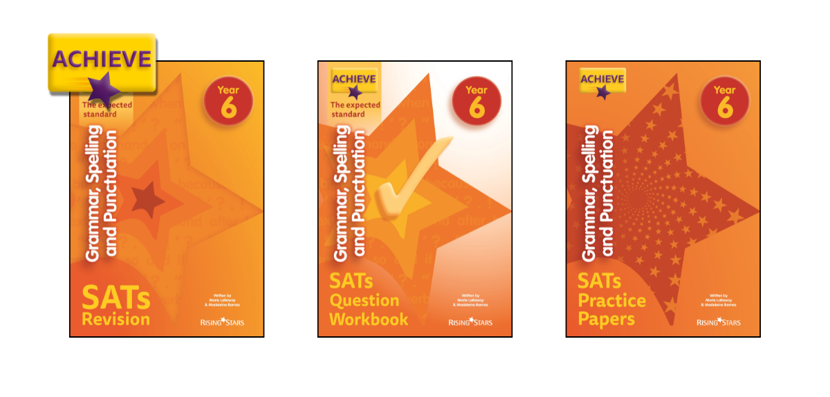
with Achieve SATs Success: Grammar, Spelling and Punctuation, co-authored by Maddy Barnes.
Help every learner reach their full potential in three steps:
- Revision Books refresh and boost knowledge in a step-by-step approach.
- Question Workbooks reinforce and apply knowledge to consolidate learning.
- Practice Papers build confidence and identify areas of difficulty ahead of National Tests.
Revision Books and Question Workbooks are available as 'expected standard' and 'higher score' editions to suit each learner.
Hear from us
Curriculum changes. New materials. Price discounts and unmissable offers. We’ll make sure you don’t miss a thing with regular email updates, tailored by subject and age group.